
Japan’s Vision for a Lunar Energy Ring
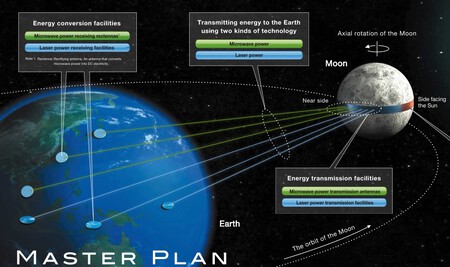
With escalating global energy demands and the drive for sustainable energy solutions, Japan has embarked on an ambitious project to create a lunar energy ring. This innovative plan aims to install a continuous belt of photovoltaic cells around the Moon’s equator, spanning 11,000 kilometers. Sunlight is constant in space, making it a prime location for solar energy capture, thus ensuring 24/7 electricity generation.
The Moon Ring Concept
Japan’s initiative, conceptualized by Shimizu Corporation, involves converting sunlight into microwaves and high-density laser beams. These energy forms would be transmitted to Earth through receiving stations, potentially revolutionizing how we harness solar power. The design is not merely a project with a set completion date; it serves more as a long-term vision, bolstered by collaboration with the Japanese Aerospace Exploration Agency, which has been studying the viability of space energy for decades.
Addressing Earth’s Energy Challenges
This lunar solar plant addresses significant challenges faced by terrestrial solar energy, namely the fluctuations of day and night, atmospheric distortion, and unpredictable weather. By bypassing these obstacles, the Moon Ring promises a steady supply of clean energy, an attractive solution as global energy requirements continue to rise. The European Space Agency has also acknowledged the strategic potential of solar energy generated in space.
The Importance of Solar Energy From Space
The materialization of the Moon Ring represents a significant step toward Japan’s “Hydrogen Society,” where hydrogen could replace fossil fuels as a primary energy source. Given Japan’s vulnerability due to limited domestic energy resources, such initiatives are vital for achieving energy independence and sustainability.
A Historical Context
While Japan’s plan is groundbreaking, the concept of space-based solar power isn’t new. The idea was first proposed in 1968 by aerospace engineer Peter Glaser. Over the years, various organizations, including NASA and the UK government, have explored the feasibility of similar ideas. With Shimizu’s transition of this concept from Earth orbit to the moon, they are taking space solar energy research to new heights.
Utilizing Lunar Resources
The practicality of the Moon Ring hinges on building solar panels primarily with materials sourced from the lunar surface. Remote-operated autonomous robots are proposed for this task, aimed at minimizing the need to transport materials from Earth. The envisioned solar ring would be approximately 400 kilometers wide, harnessing the Moon’s resources for sustainable energy production.
Transmission and Technological Viability
Energy generated by the lunar solar panels would be transmitted to Earth using a 20-kilometer-wide microwave antenna, guided by ground beacons for accuracy. The idea of wireless power transmission is not merely speculative; it has seen practical demonstration in recent studies from institutions like Caltech.
Challenges Ahead
Despite the immense potential of the Moon Ring, several challenges remain. The engineering complexity of such an unprecedented project raises questions about costs and on-site construction logistics. Additionally, cosmic radiation and micrometeorite impacts pose significant risks to the longevity and functionality of the solar panels, as noted by NASA.
In conclusion, while the Moon Ring represents a visionary approach to solving energy issues on Earth, its realization will depend on overcoming substantial technological and logistical hurdles.
For further details on Shimizu Corporation’s lunar project, visit their official page.