
Revolutionary Defensive Strategies in the Ukraine War: The Rise of “Cope Cages”
In the month of June, some disturbing images began to arrive from the war in Ukraine. We had previously seen how the first and second World Wars brought about the destruction of armored vehicles. The evolution of warfare has since transitioned from traditional combat to the innovative use of drones in modern battlefields.
This change marks a significant shift in military tactics, resembling scenes from a Miller movie . The ongoing conflict has transformed battlefields into stark reminders of a post-apocalyptic universe , characterized by military vehicles shielded with improvised armor, all aiming to withstand the threat posed by explosive drones.
A recent image taken in Kostiantynivka, north of Donetsk, features an American *Humvee* engulfed in a massive metal cage structure, with networks and sticks protruding from its design. This is a stark illustration of the *improvisation* necessary in contemporary warfare, highlighting the ingenuity of both Russian and Ukrainian forces who are evolving their tactics to combat an increasingly lethal adversary: drones that, for a few hundred dollars, can obliterate armor worth millions.
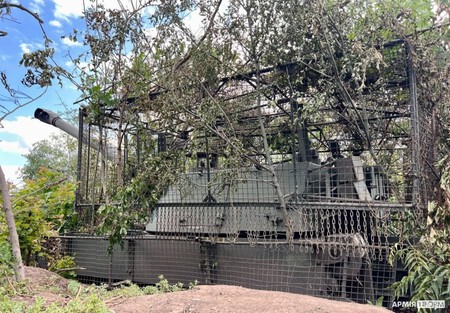
Origin and Evolution: These protective screens, known popularly as “Cope Cages”, first emerged months ago in response to the surge of drone usage. Initially, they were limited to combat vehicles, but their application has quickly expanded to various systems on the battlefield.
The designs of these defenses vary greatly: from crude and heavy structures to more sophisticated frameworks incorporating metal cages, steel plates, chains, camouflage networks, and even reactive armor. Some Russian tanks, for instance, have received such extensive coverings that they’ve been colloquially dubbed “turtle tanks”, reminiscent of a tortoise’s shell.

Industrial Adaptation: What started as mere improvisation has evolved into a more organized production system. The Russian military now distributes official guidelines for constructing these cages. Meanwhile, Ukraine has seen several companies innovate versions tailored to different military vehicles, ranging from Soviet-era *T-64* and *T-72* tanks to the US-supplied *Abrams* and *Bradley* systems, including *Patriot* anti-aircraft systems.
Despite the versatility of these structures, their actual effectiveness is up for debate. Although they provide some protection against FPV drones and anti-tank weaponry, the increased weight of these defenses can hinder mobility and operational effectiveness.
The Omnipresent Drone: The emergence of inexpensive drones has cemented their role as a game-changing factor in this conflict. They’re capable of targeting high-value vehicles or eliminating entire crews at a fraction of the cost. This has driven both sides to adopt last-ditch defenses, such as the Cope Cages, while also inspiring the development of advanced technology to counter this increasingly prevalent threat.
Electronic Countermeasures: Both Ukraine and Russia are engaging in electronic warfare, disrupting drone communications and GPS navigation systems. In retaliation, new drone models have been developed to withstand these tactics. Some feature fiber optic connections that ensure a continuous link between the operator and the drone, while others are now equipped with artificial intelligence, allowing them to complete missions autonomously even if communication is lost.

Race Between Attack and Defense: The sight of vehicles adorned with improvised cages embodies the new dynamics of warfare in Ukraine: an ongoing battle between the offensive capabilities of affordable drones and the defensive ingenuity of soldiers and engineers. Although some of these shields provide limited protection, their proliferation reflects the urgency with which both factions are adapting to a battlefield where the greatest threats may come not from advanced missile systems, but from small, inexpensive drones capable of deciding the fate of multi-million dollar combat vehicles.
As the conflict persists, the tactics employed by both sides continue to evolve, raising pressing questions about the future of warfare. The ingenuity displayed by Ukrainian and Russian forces will undoubtedly serve as a blueprint for military strategy in conflicts to come, pushing the envelope of defensive and offensive capabilities alike.