

The problem of modern wars is that they have ceased to be a geographical issue, and the current technological abilities with drones and AI are eroding the physical barriers that previously existed. This shift was notably evident during the Ukraine Spiderweb operation , targeting Russian air bases. Surprisingly, in the first 18 months of this ongoing conflict, Ukraine lost very few planes on land, especially given the number of attacks from Moscow, with predictions suggesting a continued decline in losses.
The Mobility War. The arrival of the F-16 in the Ukrainian Air Force coincided with a concerted effort to establish a mobile ecosystem that can sustain continuous operations. In this modern warfare environment, each airbase serves as a potential target for Russian missiles and aviation.
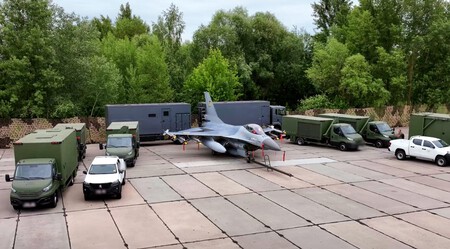
A possible solution has emerged from the Ukrainian foundation Come Back Alive, working in tandem with the state conglomerate Office 61 and the financial backing of the UKRNAfta energy firm. They have recently introduced a fleet of vehicles specifically engineered to enhance the logistics flexibility of the F-16s.
Four Wheels and Fighters. The recent acquisition included workshop trucks for preparing armament, crane trucks for missile loading, and pickups for transporting personnel. Most notably, it featured a mobile mission-planning complex built on a 6×6 truck with a habitable towing module. This innovative setup enables briefings, operational planning, and rapid movement to various locations as needed.
This investment, totaling just over 1.2 million dollars, not only brings a technical upgrade — allowing the number of operators required to assemble ammunition to drop from a dozen to three — but also provides an operational advantage that is paramount in a combat zone where speed and dispersion are synonymous with survival.
The Concept of Distributed Operations. The strategy underpinning this innovation is both straightforward and significant: to thwart Russia’s ability to predict or target Western-manufactured fighters. Ukraine has previously used alternate airbases and even highways as makeshift runways, a practice derived from Soviet strategies for austere environments. This practice, however, has been amplified by the advanced technology that the F-16 brings.
This newfound ability to move with infrastructure transforms every road into a potential airbase and every mission into a challenge of concealment. In this context, the newly acquired vehicles symbolize an adaptive doctrine in which aviation discards the notion of fixed bases in favor of complete mobility as a defense against missiles, drones, and enemy bombers.
NATO and American Learning. The lessons learned by Ukraine in these extreme conditions are being closely monitored by the United States and its allies. Recently, the Agile Combat Employment (ACE) doctrine was introduced, aimed at dispersing combat aviation across multiple temporary locations, a strategy directly influenced by Ukraine’s approach. USAF generals recognize that Ukraine’s strategic evasion techniques have significantly minimized the destruction of its air force by not repeating takeoffs or landings at the same site.
The flip side to this agility comes with logistical demands : each location requires fuel, ammunition, and maintenance equipment that must be compact, transportable, and quickly deployable. The U.S. Marines have even initiated projects to enhance air-transport compatible trucks and modular equipment that can accompany moving squadrons. This trend marks a significant shift in the conceptualization of air warfare.
Aviation Future. The tests currently unfolding in Ukraine bear significant global implications. In potential confrontations involving China in the Pacific, no military could guarantee the security of all its airbases, making mobile operational strategies essential for survival.
Fighter jets will unlikely be able to remain fixed at their airfields without robust anti-air defenses. Consequently, their operational windows will be limited to just hours or days, necessitating specific deployments for refueling and rearming before returning to primary bases. This circumstances call for a rethinking of support equipment, emphasizing lighter systems and new supporting architectures to optimize both land and aerial mobility.

Ukraine, Again a Laboratory. In summary, the introduction of these ten vehicles supporting the F-16 might appear to be a minor detail amidst the chaos of war. However, it represents a profound transformation: aviation that can no longer depend on the stability of its bases but rather on speed , dispersion , and logistical creativity .
Consequently, Ukraine has become a testing ground for a doctrine that the West, particularly the United States, considers essential for surviving in high-intensity conflicts of the future. Each workshop truck and every rolling planning module stands as a testament to how warfare demands a reimagined understanding of contemporary aerial power.
Image | “Come Back Alive” Foundation
In Xataka | A new challenge has arrived to Ukraine: it measures 4 meters, it has 75 kilos of explosives and uses AI to hit Russia
In Xataka | The last Russian tactic is not kamikaze drones: their soldiers carry a helmet with antennas that surprises Ukraine