
Military Maneuvers: The Caribbean’s Echo of Power Politics
At the beginning of September, the southern Caribbean transformed into a hybrid war theater where anti-drug operations , financial sanctions , and military deployments converged. Recent developments revealed that the United States had reactivated a military base closed for 20 years, with F-35 fighter jets continuing to arrive, adding to the tension in the region. This was marked by the deployment of F-35s, which added firepower to American military might, specifically focused on Venezuela and the regime led by Nicolás Maduro .
The Roar of the Titans
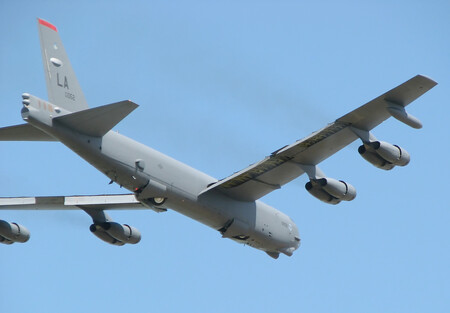
In recent days, the Caribbean witnessed a significant military operation reminiscent of the Cold War era. Up to three strategic American B-52 bombers were sighted orbiting off the coasts of Venezuela , accompanied by F-35 fighters supported by tanker aircraft and reconnaissance drones . This maneuver, executed in international airspace, was a deliberate show of force just kilometers from Caracas, designed to send a clear message to Maduro’s regime. Simultaneously, it aligned with Washington’s increased pressure and rising rumors of potential direct action against Venezuela.
Echoes of Power
The B-52s, stationed in Louisiana , flew over the Caribbean with an unmistakable purpose: to be seen . Each of these colossal aircraft can carry an array of long-range cruise missiles , enabling them to strike land or sea targets without entering enemy airspace. While the United States maintains that these patrols are part of anti-drug operations, the timing coincides with heightened threats from former President Donald Trump and recent assaults on vessels suspected of trafficking. This suggests a more profound political message directed at Maduro: Washington’s reach includes both the airspace and waters of the Caribbean.
Building the Fence
In just two months, the Pentagon has mobilized a robust naval and air presence in the Caribbean, featuring three destroyers, a missile cruiser, a nuclear submarine, and an amphibious group comprising over 2,000 marines. This force also integrates Reaper drones , C-17 transport planes , and the infamous AC-130J Ghostrider , specialized in surgical strikes. Such a build-up resembles preparation for a limited campaign rather than routine anti-drug operations. Reports indicate the creation of a new regional task force under the command of the II Marine Expeditionary Force , coinciding with multiple lethal attacks on ships in international waters that have resulted in significant casualties.
Open Threats from Washington
A pivotal moment occurred when Trump openly declared intentions of conducting strikes on Venezuelan soil after having “controlled the sea almost completely.” He acknowledged authorizing the CIA to pursue covert operations in Venezuela, signalling a significant escalation from traditional diplomatic pressure. Even though he refrained from directly mentioning Maduro, his remarks sparked alarms throughout the region. While U.S. Department of Defense sources characterize these actions as aimed at dismantling drug trafficking networks, the blurred lines between anti-drug efforts and regime change operations remain evident.
Venezuelan Response
From Caracas, the reaction came swiftly. Maduro accused the United States of orchestrating a potential invasion and lodged a complaint with the United Nations , labeling it a gross violation of international law. According to Maduro, these military movements were attempts to legitimize a regime change aimed at commandeering Venezuela’s oil reserves. In a televised address, he highlighted the CIA’s historical interventions in Latin America, declaring “Down with coups d’état!” and professing that Latin America neither wants nor needs them. He also announced a readiness of 4.5 million civilian militiamen to defend the nation, although the feasibility and numbers presented were likely overstated. Yet, the opposition, led by María Corina Machado , celebrated U.S. support and dedicated her recent Nobel Peace Prize to the cause.
The Tenuous Balance
The current situation can be described as a dangerous choreography of power. While Washington claims its mission revolves around halting drug trafficking and irregular migration, the military presence mirrors preparations for a potential military operation. Trump’s direct rhetoric evokes memories of past American interventions in Latin America, while the air and naval deployments parallel a modern iteration of big stick diplomacy .
In this scenario, Venezuela, weaken by sanctions and an ongoing internal crisis, becomes both a chess piece and a pretext for U.S. ambitions in the region. The country is a volatile nexus where U.S. aspirations for dominance and the need for an external adversary to unify Chavismo come together.
Ultimately, the flights of the B-52s along the Venezuelan coast serve as both a warning and a signal that diplomatic channels are no longer the sole metrics of influence. Instead, the focus shifts to long-range operations and military posturing, suggesting that Washington is ready to escalate tensions further if deemed necessary.
Image: USAF