

There is no doubt that China is determined to intensify its naval operations . Its unprecedented fleet of aircraft carriers, combined exercises with various nations in nearby waters, and assertive presence in disputed regions clearly reflect a global ambition . Recently, a significant addition to its naval capabilities has become evident: the deployment of spying ships known as Type 815A vessels.
The New Era of Naval Espionage has begun. The Type 815A ships have proven to be fundamental components of China’s maritime strategy, as their recurring presence in disputed waters and participation in international exercises signals Beijing’s commitment to projecting power and gathering crucial strategic intelligence.
The recent incident involving the Tianwangxing , intercepted by the Philippines Coast Guard within Manila’s exclusive economic zone , showcases this new phase of aggressive surveillance. The ship was escorting a destroyer and a Chinese coast guard vessel, further exemplifying Beijing’s strategy to enhance its naval reconnaissance capabilities.
Moreover, this operation’s timing coincided with the Aerreo Exercise Cope Thunder , where the United States deployed F-35 stealth fighters for the first time in the Philippines. This highlights how the Chinese Navy is leveraging its espionage capabilities to capture real-time data regarding the military capabilities of Washington and its allies in the Pacific region.
Expanding Fleet of Type 815A ships can be traced back to the late 1990s. During this period, China sought technological independence in naval intelligence. The first ship of this class, the Beijixing , marked a significant achievement—being entirely designed and constructed within the country. Since 2010, this class has expanded with more advanced variants entering service.
Measuring 130 meters in length and displacing 6,000 tons , these vessels are equipped with powerful diesel engines that afford them high autonomy for extended missions far from their home bases. They incorporate stealth features, such as closed masts and radar-absorbent coatings, minimizing their radar signatures, making them harder to detect.
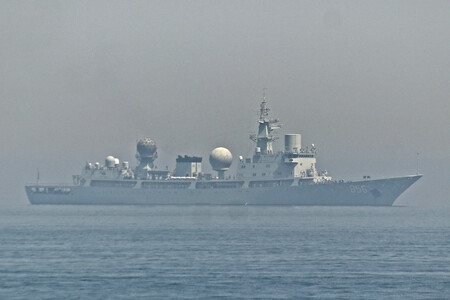
The Type 815A
Another notable feature of the Type 815A class is its large radomes , which house electronic intelligence systems (ELINT) and signals intelligence (COMINT) capabilities. These systems can capture and analyze signals across a wide range of electromagnetic spectrums.
Detection Capabilities make these ships key players in navigating the military environment of adversaries. They can detect radar emissions from aircraft and destroyers from over 700 kilometers away, with some reports stating they can track signals up to 1,200 kilometers away.
The collected intelligence is transmitted in real time via redundant satellite links tied to the Beidou system . This setup allows for immediate integration with long-range missile systems like the DF-26 and the hypersonic YJ-21 . Consequently, the presence of a single Type 815A near multinational naval exercises is akin to having a whole fleet under surveillance from Chinese striking systems.
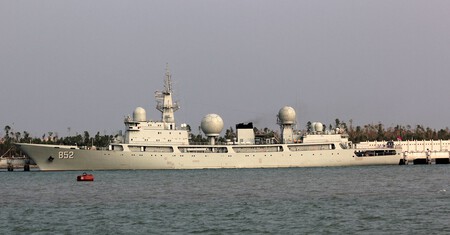
A Transition from Sea to Space is unfolding with the new reconnaissance ship Liaowang-1 , furthering this doctrine. Equipped to detect signals from up to 6,000 kilometers and monitor satellites in geostationary orbit, it vastly expands Chinese surveillance capabilities.
This advanced vessel is fitted with multi-band sensors and uses neural networks to classify targets with 95% accuracy , even amid electromagnetic interference. It employs advanced radar modules based on gallium nitride , elevating its performance significantly compared to previous generations. Liaowang-1 enhances Chinese deterrence and ushers in a new realm of early control and warning operations.
The Surveillance Strategy has become routine for Beijing, routinely deploying an 815A to monitor international military maneuvers . The mere entrance of one of these ships into an exercise zone activates China’s satellite network, turning a routine presence into a real-time intelligence operation.
For the allies of the United States, this means limiting their radar emissions and communications, weakening the effectiveness of joint operations. In a potential conflict scenario, the mere presence of an 815A could indicate that the locations of enemy ships have already been integrated into Chinese missile guidance systems.
Strategic Implications extend beyond traditional naval espionage. The Type 815A class plays a central role in China’s multi-domain warfare strategy, linking surface naval activities with airspace and space operations. However, their noticeable radar domes also make them identifiable targets.
Experts predict that future variants will integrate conformal antennas into their hulls to enhance stealth. Incorporating AI-driven command systems to coordinate drone swarms and execute electronic assaults could significantly amplify the range of Chinese intelligence efforts.

A Silent Threat emerges with the Type 815A ships. With minimal armament yet extensive intelligence-gathering capabilities, they illustrate a shift in naval warfare paradigms: it is no longer visible firepower that defines superiority but the ability to collect, process, and exploit data in real-time, guiding long-range weaponry.
China has successfully transformed these vessels into strategic multipliers, ensuring that any American military group in the Indo-Pacific remains under constant surveillance—undoubtedly a precursor to real threats from its missile arsenal. This highlights Beijing’s transition from a regional power to a potential superpower capable of dominating air , sea , and even outer space .
Image Credits: Chairman of the Joint Chiefs of Staff, Ezek, Simon Yang
In conclusion, China’s aggressive expansion in naval capabilities, particularly through the Type 815A spy ships, signifies a profound shift in maritime strategy that extends beyond traditional means of warfare. This evolution elevates the importance of intelligence and surveillance, cementing China’s position as a formidable player in global naval dynamics.