
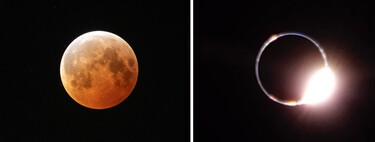
The Beauty of the Upcoming Total Lunar Eclipse
The Romans referred to the concept of origin using the term “Origo,” from which the verb “orior,” meaning “to be born,” is derived. This gave rise to the word “Ortus,” often associated with the birth of the sun or dawn. This Sunday, the world will witness a spectacular phenomenon known as the lunar eclipse , which will provide a beautiful ortho experience in the sky.
A Total Moon Eclipse. Each year, we are fortunate enough to experience at least two lunar eclipses, though not all of them are total. On September 7 , one of the longest total lunar eclipses of the decade will occur, with totality lasting approximately 82 minutes. This event will be visible from most parts of Asia and can also be glimpsed from various locations in Spain , albeit nearer to the horizon. Unfortunately, it will not be visible from America .
A lunar eclipse occurs when the Earth aligns itself between the sun and the moon during the full moon phase, projecting its shadow onto the lunar surface. The Earth has two shadow zones: the penumbra , which subtly darkens the moon, and the umbra , which blocks sunlight entirely. In a partial eclipse, the umbra appears as a “bite” out of the moon, while during a total eclipse, the full moon becomes enveloped in darkness.
A Blood Moon. During the totality phase, the moon often takes on a deep red hue, referred to as a blood moon . This phenomenon occurs because the umbra blocks the sunlight, but some rays are refracted through the Earth’s atmosphere. Rayleigh scattering , a natural process, scatters the blue wavelengths of light, leaving the red tones to dominate the view.
The blood moon this Sunday will reach its peak at 20:11 (UTC+2). Viewers in Spain will experience a fully eclipsed moon glowing with a reddish hue. The best visibility will be from locations like the Balearic Islands and the Mediterranean coast of the Peninsula , while visibility in the west—especially in the Canary Islands and parts of Galicia —will be limited with only glimpses of the partial phase.
The Full Schedule of the Eclipse. The entire sequence of the eclipse, according to the peninsular time (UTC+2), is as follows: The moon will enter the penumbral phase at 17:28 , with a visible partial eclipse beginning at 18:27 . Totality—a complete darkening of the moon—will occur from 19:31 to 20:53 . After totality, the partial phase will continue until 21:56 , followed by another penumbral phase lasting until 22:55 .
What Will Be Seen from Spain. The visibility of various eclipse phases will depend on whether the moon is above the horizon at your location. In Madrid , the moon will rise at 20:35 , allowing a viewing window of approximately 18 minutes . Generally, across most of the country, the moon will be seen exiting the horizon completely eclipsed and dyed red, except for some areas in western Galicia and the Canary Islands, where only a partial eclipse will be possible.
- In Barcelona : 41 minutes of totality from 20:11
- In Valencia : 32 minutes of totality from 20:20
- In Seville : 10 minutes of totality from 20:42
- In Zaragoza : 28 minutes of totality from 20:24
- In Malaga : 17 minutes of totality from 20:35
- In Murcia : 30 minutes of totality from 20:22
- In Palma : 44 minutes of totality from 20:08
- In Las Palmas : only partial from 20:15 (UTC+1)
- In Bilbao : 18 minutes of totality from 20:34
- In Valladolid : 12 minutes of totality from 20:39
- In Vigo : only partial from 20:56
- In Gijón : 7 minutes of totality from 20:45
Where to Look. Unlike solar eclipses, viewing a lunar eclipse is safe for the naked eye and requires no protective gear. As this event coincides with the moon’s rise, it is advisable to find a location with a clear horizon—such as a beach, lookout point, or rooftop—to enjoy the show as the satellite rises, already eclipsed and glowing red.
Image | Liquidcrash (Flickr, CC by-SA 2.0)
For enthusiasts eager to experience this celestial spectacle, now is the time to make plans. Mark your calendars for an evening filled with wonder and appreciation for our universe, as nature presents a breathtaking display that connects humanity with the cosmos in a truly remarkable way. Witnessing a total lunar eclipse can be not only an awe-inspiring experience but also a moment of reflection on the marvels that surround us.