
This Sunday on the Tropical Costa de Granada , an unusual phenomenon known as a thermal burst was recorded, causing significant chaos. While beachgoers were enjoying the summer heat, conditions shifted dramatically, culminating in hurricane-like winds. The winds escalated quickly, turning umbrellas and beach chairs into projectiles, creating a scenario that was anything but a typical summer storm.
What Happened on the Granada Coast. The sequence of events was bewildering. Shortly before 19:45, emergency services began receiving calls reporting hurricane winds capable of uprooting palm trees along the promenade. The climax of the phenomenon was noted at 19:50, with temperatures soaring to 40.1°C . Gusts of wind reached recorded speeds of 86.8 km/h , although social media reports suggested these speeds might have hit 100 km/h . The impact was felt across various municipalities including Motril, Salobreña, Torrenueva, Carchuna, and Almuñécar .
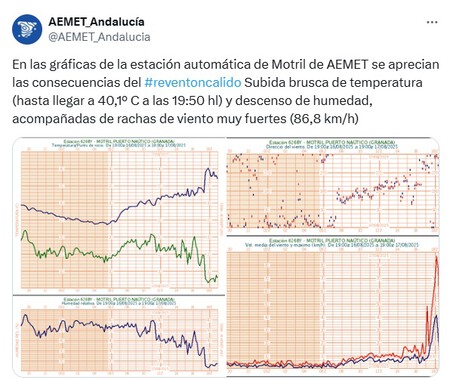
<span>Click on the image to access the publication.</span>Chaos on the Beach and Rescues at Sea. Shared testimonies on social platforms paint a vivid picture of collective panic. One visitor described the experience: “I was there on the beach, and it felt like a horror scene—I’ve never been more frightened in my life.” Images disseminated online showed crowds rushing to their vehicles, leading to traffic chaos as people tried to escape the coastline. However, the most significant danger emerged in the waters.
The rapid evolution of the storm caught many aquatic sports enthusiasts off-guard. Wind currents swept several individuals away, making it nearly impossible for them to return to shore unaided. This triggered a rescue operation that successfully retrieved seven people in front of the beaches of Torrenueva Costa and Carchuna , thanks to the efforts of maritime rescue teams and private boaters.
A Rapid Official Response. In response to the severity and unpredictability of the thermal burst, the beaches of the affected municipalities had to be evacuated. By 20:20 , Mayor Luisa García Chamorro from Motril issued urgent warnings via social media, emphasizing the seriousness of the situation and advising people to remain indoors.
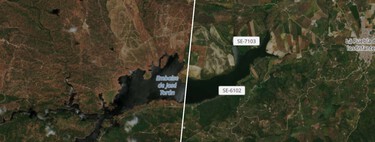
Understanding Thermal Bursts. Thermal bursts require specific atmospheric conditions to develop. The extraordinary heat accumulated during the prolonged heatwave in Granada was a critical factor. This scorching heat not only impacted the ground but also created a layer of hot, dry air several kilometers high. At the same time, the air in contact with the water remained comparatively cooler. This layering of hot and dry air above cooler, moist air is essential for the emergence of thermal bursts.
This setup was further complicated by convective storms forming in the interior mountains of Granada, which ultimately triggered the violent outburst. The formation process involves a fascinating paradox of thermodynamics, initially stemming from a cooling event and culminating in a tempest of heated air.
The Creation of a Thermal Burst. The development of a thermal burst can be dissected into four key stages:
- The Descending Current: Everything begins within a storm cloud where a powerful column of descending air generates significant rainfall.
- Sudden Evaporation: As the falling air and rain plunge, they encounter the dry air layer. This dry air quickly absorbs the precipitation, leading to complete evaporation—an event known as ‘virga.’ This evaporation consumes energy, cooling the column of air that descends at a rapid pace.
- Compression Warming: Once the cooling phase ends, the now dense air column continues to fall. The increase in atmospheric pressure compresses the air mass, resulting in a rapid pace known as the dry adiabatic gradient .
- The Impact or Burst: Finally, this hot and dense air reaches the ground, spreading horizontally with high velocity, leading to the destructive winds and temperature spikes characteristic of the phenomenon.
Not a Tornado. While thermal bursts can sometimes resemble tornadoes, they differ significantly. Tornado winds revolve around a vertical axis, whereas those of a thermal burst are linear and descending.
Climate Change Implications. Thermal bursts are naturally occurring events, but climate change is increasing their frequency. The report from the IPCC confirms that heatwaves are not just more frequent but also longer and more intense due to global warming.
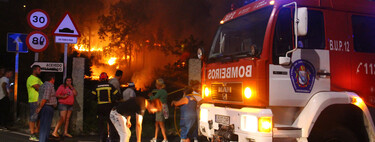
The event in Granada exemplifies these trends, emerging from a historical heatwave that impacted Andalusia . A typical storm, under normal conditions, might have produced a cold front to relieve the intense heat. However, the overheated atmosphere led to the explosive nature of the thermal burst.
More Energy, More Extremes. The growing connection between higher global temperatures and increased atmospheric moisture means that more energy is available for storms. This generates conditions conducive to severe convective storms, which are fundamental to the development of thermal bursts.
Future Projections for the Iberian Peninsula. Numerous climate studies indicate that the Mediterranean region, including the Iberian Peninsula , is experiencing climate change at an accelerated rate. Summers now last an average of five weeks longer than in previous decades, with tropical nights becoming ten times more frequent in urban areas.
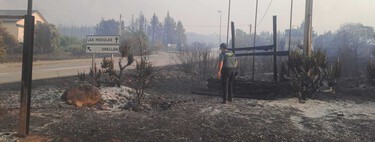
As we look to the future, it is clear that the extreme conditions that led to the thermal burst in Granada could become commonplace. With prolonged summers and amplified atmospheric energy, such phenomena are likely to increase in frequency, posing new challenges for communities along the coast.
This summer has already proven to be devastating for Spain, with a series of high temperatures leading to tropical nights and widespread wildfires affecting various regions. The interplay between climate and extreme weather is deepening, making events like the thermal burst in Granada a stark reminder of the urgent need for action against climate change.
Images: Miguel Gómez
In Xataka | There are a lot of weather apps. Determining which one is the most accurate can be challenging.