
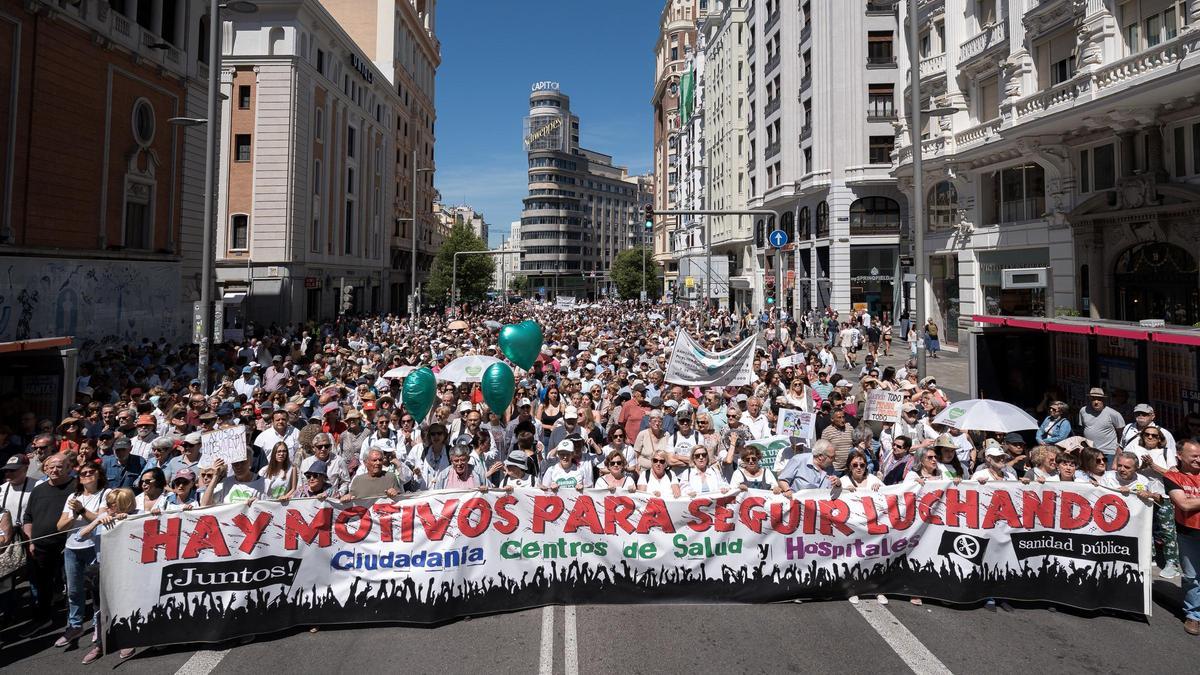
Mass Mobilization for Public Health in Madrid
On a vibrant Sunday, thousands of citizens—estimates ranging from 30,000 by government officials to 200,000 by organizers—took to the streets of Madrid in a heartfelt demonstration. The rally was organized by the platform "Vecinas y Vecinos de Barrios y Pueblos de Madrid", an alliance comprising over a hundred neighborhood associations and groups. The main focus of the march was the demand for a "universal and quality public healthcare", emphasizing that healthcare should be accessible to all, not just those who can afford private insurance.
Initiation of the March
The march commenced around noon, launching simultaneously from four key locations—Callao, Atocha, Plaza del Doctor Marañón, and Hospital La Princesa. As participants gathered in these locations, a festive atmosphere enveloped the crowd. Families, representatives from various ages, and health professionals joined in unity under the powerful slogan "Let’s Save Our Public Healthcare!". The march wound through the central avenues of Madrid, culminating at Plaza de Cibeles, where a manifesto was delivered, expressing concerns over the deliberate neglect of public health services instigated by the regional government.
The Atmosphere of the Rally
Attendees at the demonstration were seen sporting white scarves, a representation of healthcare professionals often considered as victims of the deteriorating situation, alongside t-shirts stamped with the motif "Public Healthcare" adorned with a green heart. This visual theme amplified the collective outcry against what many perceive as the systematic erosion of public health services.
Among the speakers was Juan Carlos Serrano, an emergency nurse, who articulated the distressing circumstances facing Madrid’s healthcare services. He requested that the regional government halt its exploitation of public resources and instead reinvest in what truly matters—public healthcare. His statements echoed the sentiments of many, highlighting issues like insufficient funding and endless waitlists for services.
Powerful Messages on Display
The march was characterized by eye-catching banners bearing phrases such as "Ayuso, the one who steals our health," accompanied by rhythmic sounds from percussion bands, whistles, and horns that helped to resonate the fervent message of urgency and demand for change. A striking puppet titled "La Pinocha", portraying the regional president, added a theatrical element to the protest, underscoring the rally’s lighthearted but serious undertone.
Manifesto and Demands
Upon reaching Plaza de Cibeles, a structured platform was erected where key representatives delivered a manifesto highlighting the unsustainable situations facing public healthcare. The manifesto delivered a direct message that Madrid’s public healthcare—a healthcare system viewed as belonging to the public—is being systematically dismantled by the Popular Party’s government, converting essential services into private financial gain.
Included in the demands of the gathered groups were crucial points such as re-evaluating privatization policies, increasing funding for public hospitals, and ensuring adequate staffing within health centers. Attendees stressed the necessity of providing pediatricians for all children and resolving the overwhelming numbers on waiting lists.
Widespread Support
The demonstration witnessed tremendous backing from various local organizations, notably the FRAVM (Federation of Neighborhood Associations of Madrid), key unions including CC.OO., UGT, and Amyts, as well as political parties from the left side of the spectrum. Notable figures included Manuela Bergerot from Más Madrid, and Irene Montero from Podemos, emphasizing a broad coalition supporting the cause.
The Importance of Mobilization
The essence of this grassroots movement lies in the necessity and efficacy of mobilization. The organizers stressed that participation in such protests is not only vital but has shown effectiveness in the past. The citizens’ movement previously led significant protests advocating for public healthcare and labor rights throughout the last legislative term, particularly during a prolonged strike involving doctors and pediatricians of Primary Care that lasted four months.
In late 2022, a similar rally titled "Madrid Rises for Its Public Healthcare" saw massive turnout, signaling the continuous concern and advocacy for public health. The critical situation has persisted, thus asserts the anthropological familiarity of demonstrations—showcasing unity amidst turmoil and demand for justice.
Historical Context of Healthcare Protests
The trajectory of protests demanding public healthcare in Madrid has a rich history. Notably, one of the largest demonstrations saw approximately 250,000 participants in February 2023 opposing the privatization of the health system and highlighting the dismantling actions of public services. Once again on May 19, 2024, this ongoing rallying cry witnessed around 18,000 attendees, according to government estimates, or 200,000, according to those mobilizing for the cause.
The persistence of citizens, professionals, and organizations illustrates a consolidated front aimed at preserving what they see as an essential right—adequate and equitable public healthcare.
The overall sentiment resonates with the collective urgency to foster a healthcare system that is inclusive, fair, and most importantly, accessible to every individual in Madrid, beckoning the establishment to heed their clarion call for change.