
The Panic Among Software Investors: AI’s Disruptive Role
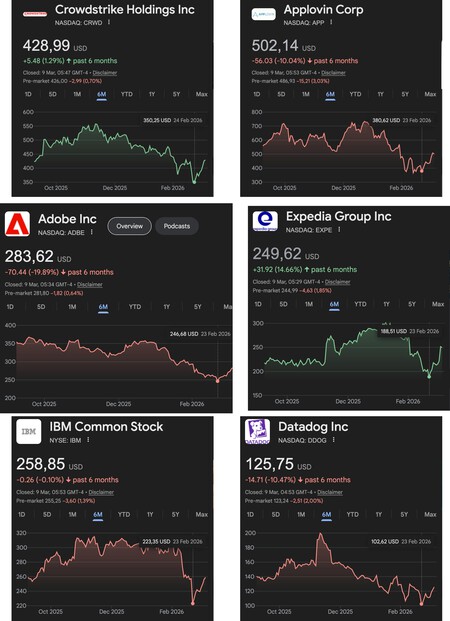
February 23 marked a catastrophic day for notable software companies like CrowdStrike, Expedia, AppLovin, Adobe, and Datadog, all of which belong to the S&P 500. These firms are grappling with a turbulent market context dominated by rapid advancements in artificial intelligence (AI) technology. In stark contrast, hardware companies are thriving amid the RAM memory crisis, highlighting a notable divide in the tech industry.
Understanding the Concerns
The panic stems from two critical factors: ongoing stock market volatility and the fear that AI will overshadow traditional software businesses. The recent flurry of activity from AI leaders like OpenAI and Anthropic has intensified fears among investors, who worry software companies could be completely sidelined as AI technologies advance.
Despite many software firms integrating AI into their offerings rather than being directly replaced by it, the emotional volatility of public investors often leads to panic selling. Reports from the Wall Street Journal emphasized that February 23 was particularly disastrous for these stocks, causing a ripple effect of fear throughout the industry.
Panic and its Effects
While the situation has begun to stabilize, lingering concerns dominate market sentiment. Investors seem convinced that new AI tools threaten to cannibalize entire software suites, eradicating roles previously occupied by human workers. This unease has made firms like IBM and Blue Owl psychological victims in a market haunted by three core fears:
- Companies relying on traditional licensing models must navigate how much AI integration will maintain relevance without jeopardizing their existing business models.
- Investors fear that AI agents could easily replicate tasks at a lower cost, thereby squeezing profit margins.
- The prospect of AI systems replacing entire software suites fuels anxiety; for instance, if OpenAI releases an AI that can manage legal documentation, companies producing such software would suffer significantly.
The Broader Psychological Impact
This panic reveals the emotional nature of investors. In volatile markets, even speculative movements can lead to rapid sell-offs. For example, when Google introduced its AI that purportedly creates video games, numerous industry stocks plummeted despite the lack of tangible impacts on their futures.
Interestingly, while organizations like Goldman Sachs highlight the “existential risk” posed by AI to traditional jobs, their CEO cautioned that the reactions in the market are exaggerated. The current market climate has seen a rise in short positions and a fall in long positions, indicating a focus on fears rather than realities.
The Hardware Contrast
In contrast to software, hardware companies are enjoying a relative boom. If there’s a widespread concern that AI could disrupt software, those producing hardware essentials for AI, like NVIDIA and TSMC, are thriving. They are the backbone of data centers essential for training and operating AI models, contributing to an ongoing component crisis.
A Future with AI Agents
NVIDIA’s CEO, Jensen Huang, has suggested that software companies will need to evolve significantly. He believes that all future software will incorporate AI agents, moving away from conventional subscription models towards a rental system utilizing specialized tokens.
This potential shift compels software companies to adapt or risk obsolescence. While many firms possess the resilience to pivot alongside technological advancements, the market’s response remains unpredictable as investors weigh their options, often leaning towards more stable assets like data center infrastructure.
As the intersection of AI and software continues to evolve, the industry remains on alert, balancing between fear and adaptation in a rapidly changing landscape.