
For years, many of us have thought of insects as something foreign to our table, but they have been part of space history for much longer than we imagine. Even before the first astronauts reached orbit, these small species had already shown that they could withstand the conditions of flight. Today, with long-duration missions on the horizon, the conversation has shifted. Europe wonders if these animals, so nutritious and easy to maintain, could become a viable option to feed those who live far from Earth.
Why Insects?
Although they are still a culinary rarity in many Western countries, insects are part of the regular diet of billions of people across the globe. The FAO estimates that over 2,000 species are consumed on different continents, valued for their contributions of protein, iron, zinc, and beneficial fats. Their ability to thrive on minimal resources while transforming waste into useful biomass makes them an attractive candidate for controlled food systems. Consequently, several European teams are analyzing their nutritional potential and viability in environments where every gram counts.
What We Know About Microgravity
Research with insects in space has accumulated decades of data, from early suborbital flights to tests at orbital stations. Throughout this journey, various species have been tested with differing results: some managed to complete essential life cycle phases in microgravity, while others showed sensitivity to factors like movement and radiation. This contrast is invaluable in understanding which biological mechanisms remain stable in space and which processes are altered in even the most resistant organisms.
What the ESA Is Looking For
The European Space Agency (ESA) is focusing on a specific goal: to understand how these organisms behave during key development phases when exposed to prolonged time in orbit. The agency has assembled diverse teams to study insects’ abilities to recycle nutrients and produce protein under controlled conditions. Candidate species include the common cricket and the mealworm. This research aims to clarify the biological requirements that must be met before considering their production for long-duration missions.
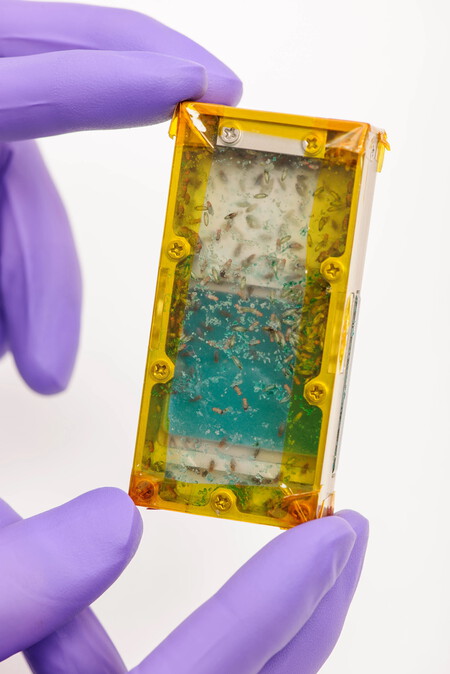
Fruit fly habitat used for scientific research in space
Despite the extensive history of testing with insects, most results are scattered and stem from short missions. Most experiments did not capture the full life cycles of species, a crucial element for evaluating their utility in extended missions. Moreover, many previous studies employed varying methodologies, which complicates comparison. As a result, ESA is preparing new studies specifically aimed at assessing changes in reproduction, development, and behavior in orbit.
Drosophila Model
NASA’s experience with Drosophila melanogaster has validated its role as a model organism for understanding physiological changes in space. The fruit fly shares many genes related to human diseases, and its rapid reproduction allows for the analysis of multiple generations. The Fruit Fly Lab on the International Space Station permits real-time behavior tracking and enables researchers to freeze samples for ground study. This facility also incorporates a centrifuge, helping to distinguish effects linked to gravity from those associated with space radiation.
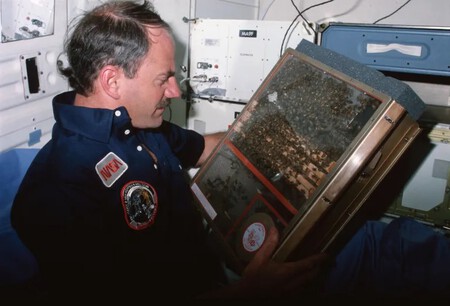
Astronaut James D. “Ox” Van Hoften examines a bee experiment
From the Laboratory to the Menu
For now, the potential food use of insects in space missions remains a focus of research rather than an immediate application. Researchers need more data on how insects behave in prolonged conditions and what it means to cultivate them stably within inhabited modules. In addition, transforming this biomass into safe, manageable, and acceptable products from both nutritional and sensory perspectives presents a challenge. The focus is leaning toward exploring options rather than directly incorporating them into astronauts’ menus.
Images | ESA | POT