
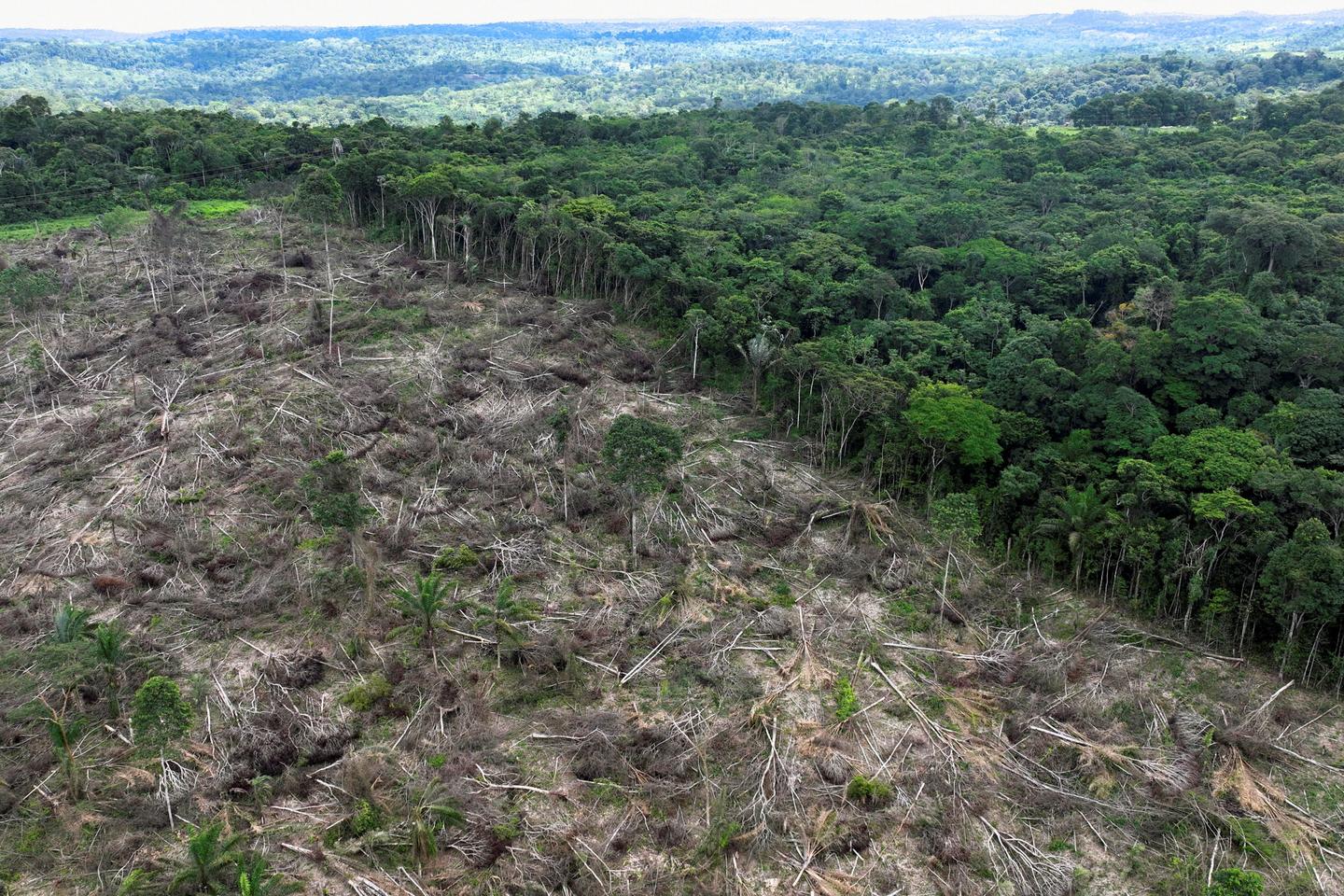
Deforestation in the Brazilian Amazon has reached its lowest level in nine years for a month of February, with a reduction of 64 % compared to the same month of 2024, according to official data published Wednesday March 12.
Encouraging figures while Brazil will accommodate the COP30 in November, the UN climate conference in the Amazonian city of Belem. The largest tropical forest on the planet plays a crucial role in the absorption of greenhouse gases.
According to the data collected by the satellites of the Spatial Research Institute (INPE), deforestation affected 80.95 square kilometers (km2) in the Brazilian Amazon in February. This is the lowest level recorded since the use of the Deter alert system in 2016. In February 2024, 226.51 km2 had been deforested there.
Deforestation also fell 24 % over this same period in Cerrado, a tropical savannah very rich in biodiversity, but the newly deforested surface remains very high, reaching 494 km2.
Spectacular increase in fires affected by fires
The Brazilian president, Luiz Inacio Lula Da Silva, on the left, is committed to eradicating illegal deforestation by 2030, mainly due to actors in the agricultural sector in search of land for breeding and crops.
Since his return to power in 2023, deforestation in the Amazon has dropped continuously, after having jumped between 2019 and 2022, during the mandate of his predecessor Jair Bolsonaro, of the far right. According to the Deter system, of INPE, it was reduced by half in 2023 (5,156 km2 against 10,278 km2 in 2022), before experiencing a new drop in 2024 (4,183 km219 % less than in 2023).
However, this data does not take into account the spectacular increase in the vegetable surface degraded by fires, as it is counted separately. The latter increased by 79 % in 2024, according to a report by the Mapbiomas surveillance platform published in January. Some 30.8 million hectares (308,000 km2) went up in smoke, it is the largest surface affected by fires in Brazil since 2019. According to official data, more than 140,000 fire starts were recorded in the Brazilian Amazon in 2024, from unheard of in seventeen years and an increase of 42 % compared to 2023.
The year 2024 was marked by a historic drought, linked, according to experts, to global warming. The fact that the vegetation is drier promotes the spread of fires, but the authorities attribute the vast majority of fire departures to human action. The agricultural sector is also in this area the main accused.