
Anomalous Explosion Detected: The Mystery of SN 2023vbw
In 2023, the Zwicky Transient Facility, an astronomical consortium led by Caltech, made a groundbreaking discovery on the outskirts of a dwarf galaxy located 1.3 billion light-years away. Initially, astronomers speculated that the detected signal was a typical type II supernova explosion. However, upon closer examination, researchers uncovered that this signal defied conventional classifications. It corresponded to a rare type of event known as a pairwise instability supernova.
What is a Pairwise Instability Supernova?
Pairwise instability supernovae are extraordinary celestial phenomena that occur under specific conditions. These explosions take place when a parent star is exceptionally massive and exists in a low metallicity environment. Unlike typical supernovae, which often result in neutron stars or black holes, pairwise instability supernovae are unique in that they lead to complete self-destruction of the star, leaving no remnants.
Detecting the Unusual
This discovery marks a significant advancement in astronomical research, as pairwise instability supernovae are incredibly rare and challenging to detect. Researchers hope that insights gained from SN 2023vbw will enhance their ability to identify similar events in the future, particularly with the forthcoming capabilities of the Vera Rubin Observatory.
Analyzing the Brightness Curve
A crucial aspect distinguishing SN 2023vbw from ordinary supernovae was its atypical brightness curve. In standard supernovae, the brightness usually reaches a plateau shape. However, in this case, after an initial cooling phase, a steady increase in brightness continued until it peaked around 190 days. Afterward, brightness began to decrease, eventually stabilizing.
Unmatched Energy Output
The total irradiation energy from this event was measured at 3×1050 Ergs, more than ten times that of a standard type II supernova. Remarkably, during its ascent, this explosion stabilized at a nearly constant temperature, requiring substantial internal heating, something not observed in typical supernovae. Furthermore, the kinetic energy produced was estimated to be 60 to 130 times greater than that of an ordinary supernova.
Understanding the Mechanism
The mechanics behind this extraordinary event differ significantly from typical supernovae. A massive star is traditionally subjected to two opposing forces: gravitational compression and outward radiation pressure. When the star exhausts its fuel, gravity dominates, leading to collapse and explosion.
In low metallicity environments, however, the star’s core can reach such high temperatures that photons can transform into electron-positron pairs, abruptly eliminating radiation pressure. This causes an intense collapse, resulting in a violent explosion that leaves no remnants.
The Role of Metallicity
Metallicity plays a crucial role in the occurrence of such supernovae. Metals usually absorb radiation from the star, assisting in the expulsion of matter. Low metallicity means that less matter is lost, thereby increasing the star’s effective mass.
The Blue Supergiant Connection
The light curves associated with SN 2023vbw suggest the involvement of a blue supergiant as the progenitor star. Typically, such stars may transition into type II supernovae; however, in this particular case, the environment’s low metallicity, about a tenth that of the Sun, was key to the pairwise instability supernova occurring.
Looking Ahead
This remarkable discovery not only enhances our understanding of the Universe’s most violent processes but also raises expectations for future explorations. With tools like the Vera Rubin Observatory and NASA’s upcoming Nancy Grace Roman, astronomers anticipate uncovering more phenomena of this nature, making the quest to detect these elusive events somewhat less daunting.
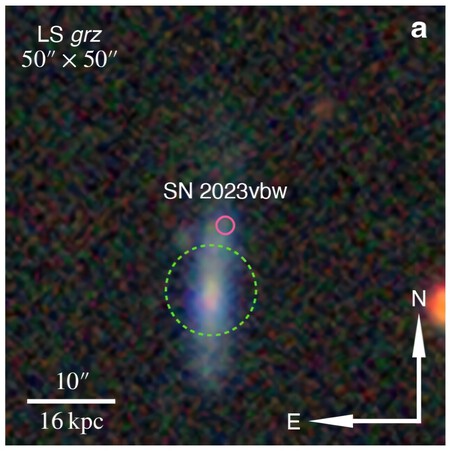
The location of SN 2023vbw (magenta circle) on the outskirts of its dwarf host galaxy (green circle).
This astonishing event confirms that while rare, pairwise instability supernovae can occur under specific conditions. As scientists continue to refine their detection techniques, understanding these cosmic occurrences may soon become more commonplace.
Image credits: Supernova remnant on cover. Credit: NASA/CXC/Rutgers/G.Cassam-Chenaï, J.Hughes et al.; other sources as credited in the original document.