

After a long delay, NASA’s Orion ship is practically ready for the first human flight to lunar orbit in over half a century. American astronauts Reid Wiseman , Victor Glover , Christina Koch , and Canadian Jeremy Hansen have been selected to experience the moon from an entirely new perspective. However, they still await a definitive launch date.
The Artemis II Mission Flight Plan
The inaugural manned mission of the Artemis program can be likened to the Apollo 8 mission in the current lunar exploration race. While Artemis II is not designed for moon landing, it does plan to orbit the moon, serving as a crucial milestone for the program. The main objective is to validate the Orion spacecraft and its rocket, the Space Launch System (SLS) , ensuring safety for astronauts venturing into deep space.
The flight plan , spanning approximately 10 days , kicks off with a launch from Florida . The initial phase includes two laps around Earth: the first orbit lasting 90 minutes and the second, a more elliptical path, extending nearly 24 hours . This second orbit will allow the crew to rise to an altitude exceeding 74,000 km , a vital step for testing life support systems before making their way to the moon.
Once all systems are verified, the Orion Ship Service Module , contributed by the European Space Agency , will ignite its engine for a translunar injection , propelling the crew into a four-day journey toward the moon.
The astronauts will fly within approximately 7,400 km of the moon’s far side, traveling farther from Earth than any humans in history. From this vantage point, they will witness the moon prominently displayed on their window while our planet appears as a small, blue marble nearly 400,000 km away.
Thanks to a “free return” trajectory , gravity from Earth and the moon will guide the Orion spacecraft back home without requiring extensive engine burns. This return journey will last another four days and culminate in a parachute landing in the Pacific Ocean . Remarkably, during this mission, they are expected to reach the highest speed ever attained by humanity.
Four Astronauts Waiting Since 2023
In April 2023, NASA introduced the world to the four astronauts selected for the Artemis II mission . This veteran trio includes Commander Reid Wiseman and pilot Victor Glover (both with prior experience on the International Space Station ), along with Christina Koch , who holds the record for the longest single spaceflight by a woman.
From the Canadian Space Agency, Jeremy Hansen will join them, marking his first trip to space as part of the Artemis II mission.
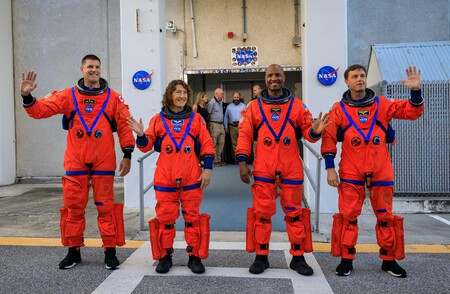
Initially slated for a late 2024 launch , Artemis II has now been postponed to April 2026 . The thermal shield of the Orion ship failed to perform as expected during its inaugural mission. Inspection found significant material loss, prompting the necessary delay.
While Artemis I was deemed a success, subsequent evaluations revealed concerns with the thermal shield. NASA identified that gases generated during the re-entry process could not escape properly, leading to pressure buildup and partial detachment of the shield. This unexpected issue, along with challenges in life support systems, necessitated a reevaluation of timelines and ultimately pushed Artemis II’s launch to April 2026.
Everything is Already Perfectly Rehearsed
Far from twiddling their thumbs, the selected astronauts have been engaged in a rigorous schedule of trials . In early August, they donned their space suits and entered the Orion capsule for the first time. This session, conducted with the ship fully fueled, allowed them to connect life support systems, simulating launch day conditions.
Soon after, the Orion capsule was moved to the assembly building where, on August 27, technicians finished installing the launch abort system , designed to safely separate the crew in case of an emergency.
Emergency scenarios were also rigorously rehearsed. In June 2025, NASA and the U.S. Department of Defense conducted extensive rescue drills off the coast of Florida. Helicopters, rescue parachutists, and recovery equipment were utilized to practice extracting the crew in case of an emergency.
In Houston, the Mission Control Center is gearing up as well. On August 15, a new Orion Mission Evaluation Room was unveiled, where NASA engineers and international partners will monitor every data point during the flight. Complete simulations have already taken place within this new facility.
While the primary aim is technical validation, Artemis II also serves a scientific purpose. The crew is set to observe the moon from a unique angle that hasn’t been seen by human eyes before. To capitalize on this opportunity, they have undergone intensive training in geological formation to enhance the overflow’s scientific yield.
Despite not landing, the astronauts may be the first humans to witness specific areas of the moon’s far side, particularly the Eastern Basin . They will document impact craters and ancient lava flows, providing essential information that could guide future Artemis III missions, which aim to return humans to the moon’s surface since 1972—unless China achieves this milestone first.
Images | NASA
In conclusion, the Artemis II mission represents a pivotal step in humanity’s return to the moon. With a blend of seasoned astronauts, advanced technology, and rigorous testing, this mission promises to push the boundaries of space exploration while laying the groundwork for future lunar endeavors.