
Imagine one day, while exploring the outdoors with a metal detector, you stumble upon a strange reddish rock. Instinctively, you take it home, convinced it may contain gold. Despite your best efforts to crack it open, the rock remains an enigma—almost impervious to everyday tools like grinders.
This is precisely what happened to David Hole, an Australian who roamed the striking landscapes of Maryborough Regional Park with his metal-detecting gear. Initially enticed by the possibility of finding gold, he would soon discover that this peculiar rock was a far more significant treasure: a meteorite, likely originating from Mars or Jupiter.
The Discovery of the Maryborough Meteorite
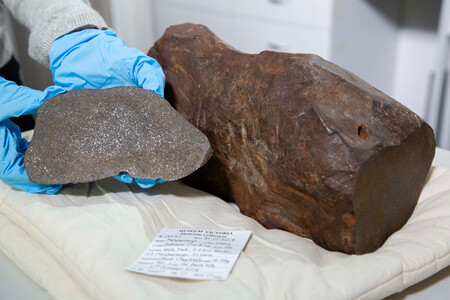
Discovered in 2015, the cosmic rock’s true identity eluded Hole until 2018, when he took it to the Victoria Museum for a proper examination. Geologists Bill Birch and Dermot Henry quickly suspected it could be a meteorite, a surprising conclusion since most people bring simply ordinary rocks to the museum.
The analysis teams measured the rock at 38.5 cm x 14.5 cm x 14.5 cm and initiated an extensive study that included a small cut to analyze its internal composition. The results revealed that Hole’s find was indeed a meteorite, classified as an H5 chondrite, which typically has a high percentage of iron. This suggests that it was formed in the asteroid belt between Mars and Jupiter.
The Origins and Age of the Meteorite
Determining the exact origin of the Maryborough Meteorite remains a subject of hypothesis, as researchers have not conclusively pinpointed where it came from or when it impacted Earth. However, radiocarbon dating suggests that the rock has existed on our planet for between 100 and 1,000 years, with estimates suggesting it may have entered our atmosphere between 1889 and 1951.
The Value of the Meteorite
When comparing the value of a meteorite to gold, it’s a complex situation. However, the Victoria Museum emphasizes that the meteorite is indeed much more valuable. Finding gold in Australia is relatively common compared to this extraordinary find, which marks only the 17th meteorite discovered in Victoria. According to experts, meteorites serve as invaluable scientific artifacts that offer insights into the history of our Solar System.
The Scientific Significance of Meteorites
Meteorites like the Maryborough specimen are vital for scientific research. They provide essential information about the formation of elements in the universe, offering unique opportunities to study their characteristics and chemical composition. This research complements ongoing space exploration missions, such as those using the James Webb Space Telescope and the ambitious OSIRIS-REx program.
In summary, what began as a mere quest for gold turned into a significant astronomical discovery, making the Maryborough Meteorite a treasure not of wealth, but of knowledge.
Images | Museums Victoria