
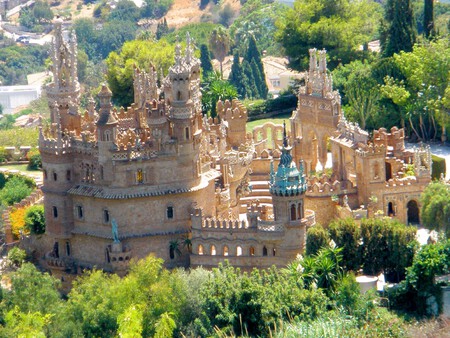
Colomares Castle: A Tribute to Columbus
In 1990, the Guinness World Records team visited Malaga to register a remarkably small Catholic church. What set this church apart wasn’t just its size but its unusual location: it was tucked away inside a castle built by a retired doctor who dedicated years to a rather unique historical obsession.
A Castle Born of an Obsession
In 1987, at a time when most individuals would typically enjoy their retirement, Dr. Stephen Martin Martín embarked on an extraordinary project. After decades working as a gynecologist and surgeon in the United States, he returned to Spain, convinced that Christopher Columbus deserved more recognition. Thus, he resolved to build a monument by hand to rectify this oversight.
What began as a personal vision on a plot of land in Benalmádena evolved into one of the most peculiar constructions on the Costa del Sol: Colomares Castle, a contemporary castle that appears to have sprung from another era, defying any conventional architectural classification.
Seven Years, Three Men, and No Machines
The scale of this undertaking is astonishing. Between 1987 and 1994, Martín worked alongside bricklayers Juan Blanco and Domingo Núñez, using only their hands and traditional construction techniques inspired by the Late Middle Ages.
With no access to large machinery or institutional funding, the trio transformed raw materials—stone, brick, cement, and wood—into a structure measuring approximately 1,500 square meters and standing over thirty meters high. The project consumed a significant portion of Martín’s savings, yet he persisted despite skepticism from those who labeled him an eccentric dreamer.
An Encyclopedia of History
Although commonly referred to as a castle, this monument serves as a monumental story in stone, narrating the voyages of Columbus and Spain at the close of the 15th century. Each corner of the castle contains symbols, characters, and historical references, all designed to impart historical knowledge visually.
The structure amalgamates neo-Gothic, neo-Romanesque, neo-Mudejar, and neo-Byzantine influences, creating an architectural outdoor manual. Among towers, staircases, stained glass windows, and sculptures, viewers will find allusions to the Catholic Monarchs, the navigators of the Columbian expedition, and significant events related to the discovery of America.
The Three Cultures and an Unfulfilled Dream
One of the most unique aspects of Colomares Castle is its intention to reflect the coexistence of Christian, Muslim, and Jewish cultures that thrived in Spain during that era. This cultural blend is apparent in various decorative details throughout the construction.
Unexpectedly, a Chinese pagoda rises between medieval towers, reminding visitors that Columbus never intended to discover a new continent but sought a route to Asia when he set sail.
The Tribute of Stone Caravels
Colomares Castle is rich in references to Columbus’s 1492 expedition. The silhouettes of the Niña, Pinta, and Santa María are intricately integrated into the structure, appearing to navigate an ocean of stone. La Niña is prominently showcased beneath the La Rábida arch, La Pinta is part of the main façade, and Santa María stands separate as a reminder of its shipwreck.
The Hidden Treasure: The Smallest Church
However, the most astonishing surprise within the castle is the Chapel of Saint Elizabeth of Hungary, often cited as the world’s smallest Catholic church by the Guinness Book of Records, measuring only 1.96 square meters.
This contrast is captivating—a monumental tribute to a pivotal story in Western history houses a temple so tiny that it can accommodate barely one person. Reports suggest that during various ceremonies, the priest may have been the only occupant inside while the rest remained outside.
Legacy of a Dreamer
Originally, Martín envisioned the monument as a research center dedicated to Columbus, even hoping to house the explorer’s remains. Though these dreams faded when he abandoned the project in 1994—disheartened by the lack of attention during the 500th anniversary of America’s discovery—time has ultimately granted him the recognition he sought.
Today, Colomares Castle stands as one of Spain’s most unique architectural marvels, blending history, art, symbolism, and personal obsession into one striking edifice. Its continued ability to astonish reflects the very paradox that defines it: an impossibly constructed castle that houses a church so small it challenges the conventional understanding of monumentality.