
With tens of thousands of hectares burned, hundreds of people evacuated, and several lives tragically lost, the devastating impact of forest fires can be felt in numerous communities. However, amidst the turmoil, there emerges a beacon of hope. On Thursday, the College of Engineers of Montes (Coim) reported a remarkable “ancestral formula” that has enabled parts of the rural areas in the provinces of Soria and Burgos to defend themselves against the relentless threat of flames.
Its name: “Good Luck of Pines.”
In a place in Soria… Conversations about fires in Spain often revolve around charred landscapes, increasing evacuees, and prolonged state of emergencies. Thus, the announcement of a rather different tone from Coim on Thursday stands out. They shared that the Pinares region , nestled between Soria and Burgos, seems to have stumbled upon a formula to reduce the risk and severity of forest fires. Nestled within this area is the Natural Park of Laguna Negra and Urbión’s glacier circuses , which hosts some of the largest pine forests in Europe.
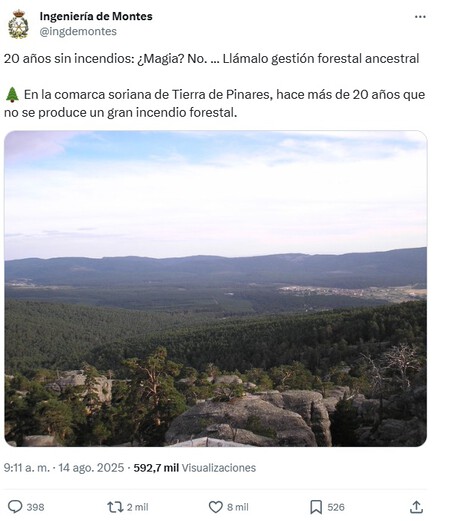
<span>Click on the image to go to Tweet.</span>Three words: luck of pines. “In the Soriana de Pinares region, it has been more than 20 years since a major forest fire occurred. Is it magic? No! It is due to ancestral forest management,” explains the school, highlighting that this unique protective measure stems from the “Good Luck of Pines” , an ancient practice that grants residents a set of rights and responsibilities concerning forest management. Just days prior, a lightning strike ignited a fire in Vinuesa, the region’s capital, but it was quickly extinguished. Coincidence? Hardly,” they emphasize.
On Wednesday, Heraldo de Soria reported various fire alerts that thankfully did not escalate in Tera, Gómara, and Vinuesa. A fire spark, likely caused by lightning, was recorded early that morning but was suffocated within an hour, affecting only a meager 0.01 hectares of grassland.
What is the fate of pines? As pointed out by Coim, this isn’t sorcery; the Luck of Pines is a systematic approach to managing forest resources, a time-honored practice rooted in history, tracing back to the “PUEBLAS LETTERS” from the Middle Ages that forged a strong connection between local communities and their forests.
“This deep-rooted connection has fostered a community that not only relies on the resources of the mountain—such as wood, hunting, and tourism—but actively protects it,” the school articulates, stressing that this practice includes ongoing collaboration among local institutions, prevention strategies, and continuous monitoring.
<img alt="The megaindios of Ourense, Zamora and León have paralyzed the Galician bird. It is the nth setback in a horrible year for Renfe " width="375" height="142" src="https://i.blogs.es/62c145/renfe/375_142.jpeg"/>Diving into specifics. While it may sound abstract, the philosophy behind this system is rooted in simplicity: it focuses on distributing forest resources among community members. The woods harvested from local pine forests are allocated through a lottery, ensuring that beneficiaries must meet certain criteria, largely to preserve their ties to the community. This process nurtures a strong sense of local identity.
“The Luck of Pines is not just about woodland exploitation; it weaves itself into the fabric of community life, representing a tradition passed down through generations. The Cultural Importance of this practice is recognized, recently classified as an intangible cultural asset by the Junta de Castilla y León,” they summarize.
How is it implemented? “Woodlots are periodically allocated through communal concessions,” explains the Board. “These divisions provide prescribed shares among beneficiaries, which over time transitioned from physical wood to monetary compensation to facilitate management and conservation tasks.”
Local municipalities oversee the registration of participants, often imposing criteria like residency duration or family lineage. This ancestral practice currently spreads across the Soria-Burgos Pinares region and extends to cover approximately 100,000 hectares of native forest.
<img alt="Fire in Spain 2025: How to see them on Google Maps, other maps and pages to have all updated information. " width="375" height="142" src="https://i.blogs.es/bd3d7c/mapas-incendios/375_142.jpeg"/>Is this a modern concept? Not at all. The Junta recalls that written references to this practice date back to the 16th century , although it has deeper roots. The royal privileges granting resource rights from the mountains emerged during the Middle Ages amidst territorial repopulation efforts. Over the ensuing centuries, the practice solidified further.
Into the 20th century, these practices were codified through regulations that transformed customary practices into formal laws. Beyond its historical significance, the Board extols its benefits, particularly its role in linking individuals to their environment and combating rural depopulation. “It provides substantial economic appropriateness for local inhabitants,” they assert.
The Soriana solution. While the Luck of Pines may be a critical component of the broader Forestry Management Strategy in Soria, questions surrounding the low incidence of forest fires there have persisted among various media outlets. Observers usually ponder, “Why doesn’t Soria burn?” This question was particularly poignant in the summer of 2022, another challenging season for Spain’s landscapes, highlighting the province’s expansive 600,000 hectares of forested land.
The response lies in the voice of Pablo Sabín , director of the Forest Services and Promotion Center in Castilla y León. He attributes this resilience to several factors, including managed forest systems and community involvement, while noting Spain is facing a period of juvenile forest structures with limited mature woods.
Images | Ministry of Defense (X) and Manuel López (UNSPLASH)
The longevity of the “Luck of Pines” stands as a testament to the strength of community and sustainable practices, offering a glimmer of optimism amidst the pervasive challenges that forest fires present today.