
The Case of Soham Parekh: A Silicon Valley Deception
Silicon Valley may seem like an ecosystem of companies in which, more or less, everyone knows each other, and engineers jump from one organization to another as if in an exchange of trading cards . However, a simple message on X unveiled the unusual case of Soham Parekh , an Indian engineer who allegedly worked across several startups focused on artificial intelligence (AI) .
At first glance, this might not seem strange ; many engineers juggle multiple jobs. The nuance , however, lies in the fact that Parekh reportedly deceived his employers while leaving a trail of doubts about the authenticity of his claimed skills.
A message raised the hare. The saga began when Suhail Doshi , co-founder and former CEO of Mixpanel , posted a cautionary note on X: “There is a man named Soham Parekh (in India) who works simultaneously in three or four startups . He has been taking advantage of companies like Y Combinator and others. Be careful,” he warned.
Doshi explained that Parekh had been briefly employed at his company, Playground AI , but was fired within his first week when the deception was uncovered. To everyone’s surprise, following Doshi’s publication, at least five CEOs and founders of other startups echoed his claims, stating that they had hired Parekh during that same timeframe. “It has been doing this for years and works in more than four startups simultaneously,” confirmed Nicolai Ouporov , CEO of Fleet AI .
Soham Parekh’s method. Parekh’s modus operandi exploited the remote job opportunities offered by startups, allowing him to sign up with multiple companies all at once. When one company eventually discovered the truth and terminated his employment, he seamlessly transitioned to another startup.
In essence, Parekh’s main role was not to contribute to the startups that hired him but to ace the interviews that would get him hired.
Applying his impressive technical and communication skills , Parekh managed to impress recruiters during online interviews. “The guy was so intelligent during the interview that it was unbelievable. Something felt off, so thankfully I didn’t hire him,” shared Justin Harvey , co-founder of Aivideo . Another founder, Adish Jain from the AI agents company for Mosaic video editing , corroborated the concerns: “I confirm it. This guy wasted our time for a month. He excelled in the interviews but is a liar.”
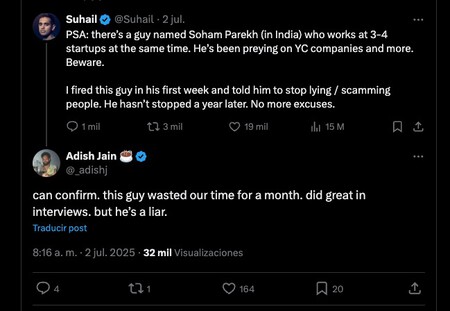
Touch the image to go to the original message
An impeccable curriculum … to be false. Parekh’s resume claimed he had worked for notable companies like Dynamo AI , Union AI , Synthesia , and Alan AI , in addition to holding a degree from the University of Mumbai and a master’s from the Georgia Institute of Technology . However, Doshi noted that “90% of his CV appears fabricated, and most of the links no longer work,” attaching a screenshot of Parekh’s curriculum.
Several founders who previously hired Parekh began publishing the emails he had sent as cover letters. Unsurprisingly, they all followed a similar template , changing only the company name or the recipient’s name.
Parekh seams. Despite the quirkiness of the phenomenon, now dubbed #sohamgate , what it has truly exposed are the flaws of ineffective, and even negligent, recruitment processes that fail to verify candidates’ CVs or references. “They should pay you to expose their failed contracting processes,” remarked a software engineer on social media.
In this instance, many of Parekh’s unauthorized employers belonged to the Y Combinator network , an incubator that has nurtured some of the most successful startups in the tech world. However, it might have gone unnoticed had it not been for the interconnected ecosystem surrounding this prominent business accelerator.
The ethical dilemma. This saga raises important ethical questions about working for multiple companies while remote. This is not a novel issue; as telecommuting became more prevalent, numerous instances have surfaced where workers exploit this model to balance duties at múltiples positions.
Yegor Denisov-Blanch , a researcher at Stanford, mentioned that his team has access to a private database encompassing over 100,000 engineers working for more than 1,000 companies, representing about 0.5% of developers worldwide. “Within this ‘little’ sample, we often find engineers juggling two or more jobs,” he noted. According to Denisov-Blanch’s calculations, more than 5% of all engineers have multiple remote jobs .
Understanding the implications of events like these can help improve hiring practices in technology and other sectors, ensuring transparency and integrity within the workforce.