
The Impact of Education on Salary: An Insight into Spain’s Work Market
Does education significantly influence income? Is holding a higher degree synonymous with a better paycheck ? These are common questions that have sparked debates over the years. The answer is made abundantly clear in the latest report on education indicators, published recently by the Spanish Government.
The Education-Salary Connection. According to the State System of Education Indicators, compiled with data from 2022, the Ministry of Education tackled some crucial questions regarding education in Spain. A particularly contentious topic is the relationship between educational attainment and income. Does a graduate earn more than someone who has completed only a basic education? The statistical data suggest a resounding yes .
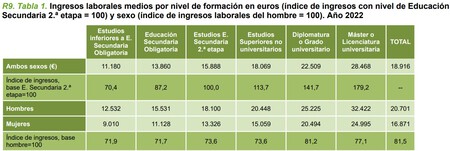
Average Income Highlights. To start, the report notes that the average labor income in Spain for 2022 stood at €18,196 . This figure represents a general overview of the economic landscape. However, when broken down by educational attainment, significant disparities emerge. For instance, the report reveals that individuals without even a basic secondary education (ESO) earn an average income of €11,180 , while those with higher education qualifications, such as a master’s degree, can expect to earn an impressive €28,468 .
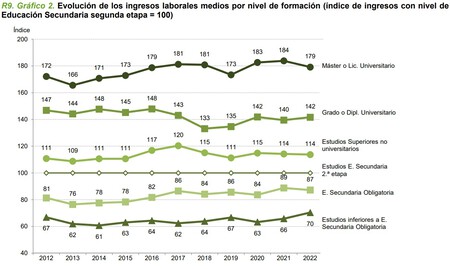
Diving Deeper into Income Levels. The report confirms that the pattern of increasing income with educational qualification holds steady across the spectrum. Those who have completed the first stage of ESO earn a median income of €13,860 , while individuals who finish the ESO earn approximately €15,880 . Moreover, those pursuing further education without attending university see their average income rise to €18,069 . Graduates holding a university diploma or degree earn around €22,509 . The projection continues upward, with advanced degrees consistently linked to higher salaries.
Factors Beyond Education. While educational qualifications certainly play a pivotal role in determining salary, the report also highlights other influential factors . Work experience is crucial as well. For example, among individuals lacking a secondary education, the average income for newcomers in the job market with fewer than ten years of experience is merely €9,125 . In contrast, those who have spent at least thirty years in the same field make about €11,332 on average.
The gap appears even more pronounced among graduates. Early-career professionals with a bachelor’s degree earn an average of €18,319 , while seasoned professionals with over thirty years of experience witness their income soar above €31,100 . According to the Ministry of Education’s report, workers in Spain with 30 or more years of experience receive approximately 62.3% more income than their counterparts with under 10 years of work experience.
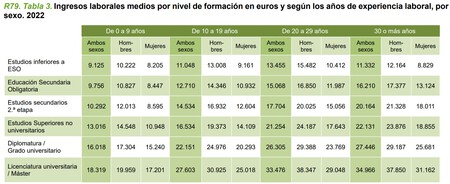
Gender Disparities in Salary. Notably, the report also reveals significant salary disparities based on gender. The average income in 2022 for men was €20,701 , compared to €16,871 for women. This gap persists irrespective of educational qualifications or years of experience. Among highly qualified professionals, men with master’s degrees or higher, who have more than thirty years of experience, earned €37,850 , whereas their female counterparts made only €31,162 .
Furthermore, women with only basic secondary education earn an average of €11,128 , compared to €15,531 for men, indicating a difference of 28.3% . On the opposite end, female university graduates earn about €20,494 , compared to €25,225 for men, marking an 18.8% disparity.
Further Insights Beyond the Report. The realities outlined in this education report align with other findings as well. For instance, the Spanish National Statistics Institute (INE) also identifies glaring discrepancies in income levels based on educational background. Individuals with incomplete primary studies earn a gross average salary of just €1,400 monthly, while those with advanced degrees earn above €2,600 .
Additional reports, such as one from Bankinter, corroborate this data, indicating that the lowest qualified workers earn 35.7% less than the national average, while the most qualified professionals exceed the average by 65.8% .
Various factors culminate in education playing a pivotal role in determining income, but it’s crucial to consider experience and gender disparities as well. The evidence consistently underscores that higher education correlates with better financial outcomes, yet significant gaps still exist that warrant attention from policymakers and society as a whole.