
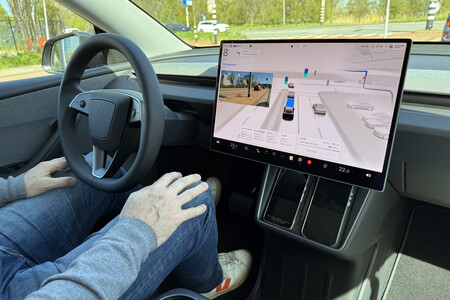
Experiencing Tesla’s FSD (Supervised) System
As I recall an iconic scene with Luke in his X-Wing, it resonates more than ever: “I’d prefer to keep manual control for a while.” This craving for control mirrors my experience with Tesla’s Full Self-Driving (FSD) system, which I tested for a full day. Despite feeling amazed, I couldn’t shake the desire for manual driving when needed.
Understanding FSD (Supervised)
Our journey into the FSD system began in Amsterdam, where Tesla had gathered a group of European journalists for firsthand experience of this newly approved technology in the Netherlands. With a guide seated comfortably, hands off the wheel, the Tesla drove itself flawlessly.
The wow factor hits hard; seeing the wheel turn on its own and sensing the smooth, precise navigation left me in awe. However, it’s crucial to understand that while FSD handles driving, the human supervisor remains responsible. This supervision entails a continuous watch on the road, ready to take control when necessary.
Attention is Key
This isn’t a pass to zone out. Users must remain engaged, contrary to the misconception that one can relax fully. The responsibility is unequivocally yours, making it essential to stay alert at all times.
How Tesla’s FSD Operates
The FSD system is impressive, especially in urban environments. It maneuvers through roundabouts, makes automatic lane changes, and stops at traffic signals seamlessly. Its ability to detect obstacles, including pedestrians and cyclists, adds to its safety record. However, I noticed limitations, such as failing to identify horses in my test.
Using advanced camera technology, Tesla’s FSD navigates roads but also relies on extensive data from millions of miles driven, enhancing its neural network capabilities. This prowess allows the system to excel in real-world scenarios.
Performance Insights
The system’s performance was remarkable. During tests, the vehicle made cautious decisions, such as waiting for a bus to complete its turn. It respected cyclists’ space and avoided abrupt movements, offering a gentle driving experience, which improves energy efficiency. We achieved an impressive average consumption of 124 Wh/km over 150 km, highlighting the advantages of cautious driving.
Safety and Supervision
The FSD system is governed by strict supervision protocols. Upon activating FSD, an internal camera monitors driver attention, issuing warnings if one’s gaze drifts away from the road. If distractions persist, it could temporarily deactivate the FSD functionality.
This clarity is vital: while the system enhances driving safety, it’s not infallible. Even with no major mishaps during my trial, it doesn’t mean it won’t make errors. Observations and feedback from other users confirm that there are limitations to its functionality.
The Future of Autonomous Driving
Despite its name, Tesla’s Full Self-Driving system is not completely autonomous. It operates at a Level 2 automation, demanding constant human oversight. Elon Musk’s initial lofty promises have drawn criticism as realities have tempered expectations. While users may anticipate a fully autonomous vehicle, it remains a proficient driver-assistance tool at this stage.
Potential and Cost Implications
In the Netherlands, Tesla charges around 7,500 euros for the FSD feature or 99 euros monthly, allowing flexible usage depending on driving needs. However, only new vehicles equipped with the latest hardware can benefit fully from this system, leaving older models in the shadows.
Implementation in Spain
Although FSD (Supervised) has not yet made its way to Spain, Tesla is actively testing the waters. Positive results from trial runs hint at potential future availability.
Conclusion: Trusting Technology
The introduction of Tesla’s FSD system raises interesting discussions around driver reliance on technology. While its capabilities are commendable, the essential question remains: are we ready to trust machines with the responsibility of driving? Like Luke, when the scenario demands, many might prefer manual control.