
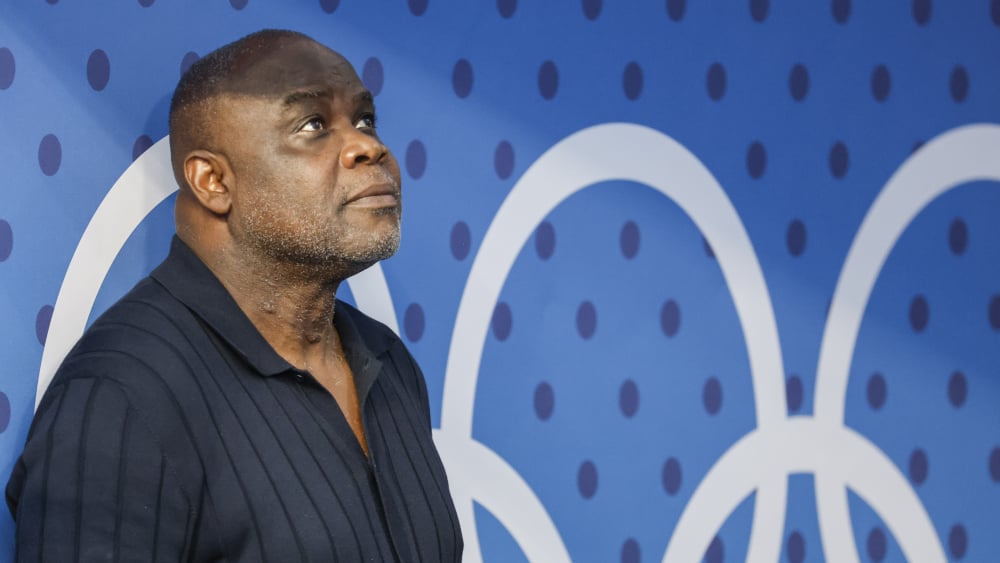
Recent statements from Basile Boli , a legendary figure of Olympique de Marseille (OM) , have caused quite a stir among the passionate supporters of the football club. Remembered fondly ever since his iconic header led OM to victory in the 1993 UEFA Champions League , Boli remains a significant symbol of the club’s rich history. So, when he declared his support for Paris Saint-Germain (PSG) during their Champions League final against Inter Milan in Munich, emotions ran high among Marseillais fans, eliciting reactions that oscillated between disbelief and anger.
As is often the case in today’s world, social media exploded with reactions, swiftly placing the former defender in the center of controversy. Many fans vowed that the next time they encountered Boli, they would give him a rather cold reception . The discontent swept through the city, leaving a bitter taste among those who bleed blue and white.
Voicing his disagreement with Boli’s statement, former teammate Éric Di Meco expressed his surprise and disappointment. While speaking on RMC, he stated, “When I read that, it hurts,” reinforcing the divisive nature of Boli’s stance. This topic further fueled discussions during a recent gathering for Djibril Cissé’s jubilee in Auxerre, where football enthusiasts debated the implications of Boli’s words.
“I am Marseillais for life, but I am French first“
Following the backlash, Boli remained silent for some time. However, he finally decided to clarify his comments during an interview on the France Télé program, “Mission info”. He explained, “This was a show meant for children aged 7 to 11, something light-hearted. My remarks were taken the wrong way. I might have offended some people, but I am not supporting anyone and I am certainly not at odds with OM. It has been 32 years since a French team won the Champions League. I am Marseillais for life, but I am French first. Everybody understands the rivalry between OM and Paris. Like Zinédine Zidane and Didier Deschamps , my heart can only be blue and white. I reiterate, I did not say that to support Paris. When Nadal faces Monfils in tennis, I support Monfils because he is French, even if the opponent is stronger.”
In an effort to further explain his comments, Boli emphasized, “I cannot be Parisian; it’s impossible! The OM has given me so much during my four seasons (1990-1994) that no one can ever provide me with that much. Before coming to Marseille, I hardly scored any goals with Auxerre, but at OM, I found my scoring touch. I will watch the final on Saturday, but what matters most to me is that the Olympians qualify for the Champions League next season.”
Looking ahead, there exists the possibility that Boli might encounter Eric Di Meco in the Vélodrome as emotions continue to run high. Boli concluded with a nonchalant attitude, saying, “I don’t care at all about what he said,” showcasing his ability to move past the contentious exchange.
The situation has ignited a broader conversation about the passion and loyalty that fans harbor for their respective teams. In football, rivalries extend beyond the pitch, reflecting deep emotional connections that often lead to heated debates among supporters. While some may argue for national pride and enthusiasm for homegrown talent transcending club loyalties, others may find it *unthinkable* to support a rival like PSG.
In an age where loyalty to a football club is considered sacrosanct, the intersection of personal sentiment and nationalism complicates the dialogue. Boli’s comment exemplifies how sentiments can be misinterpreted, especially when communicated in a lighter context meant for children. One cannot ignore the fervor that accompanies such statements, especially in a city like Marseille, where passion runs deep.
The debate around Boli’s comments also illuminates how football serves as a microcosm of society; fans bonding over shared experiences, while simultaneously grappling with the complexities of rivalries and supporting national interests. The mixed emotions surrounding this incident not only speak to Boli’s legacy but also serve as a reminder of the enduring power of football to spark conversations around identity, loyalty, and community.