
The Election of Presidents in Colombia’s Congress
Overview of the Election Process
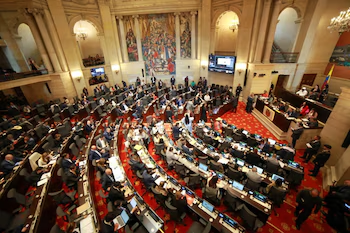
Every July 20, the Congress of the Republic of Colombia holds internal votes to elect the presidents of the Senate and the House of Representatives. These positions are crucial for the effective functioning of the Legislative Branch and have a duration of one year. In practice, candidates are often determined by pre-existing agreements between parties and their respective groups.
Structure of Leadership in Congress
In addition to the dual presidencies, the Senate also elects a Board of Directors annually. This includes a president, a first vice president, and a second vice president. Re-elections are not permitted for these roles within the same constitutional four-year term.
The election of the Senate’s president is designated to the 108 senators, while the House of Representatives’ president is chosen by 188 representatives during the legislature’s installation session. Both chambers engage in this electoral process through a vote among the members present.
Voting Mechanism
In the Senate, the election is managed autonomously and employs a secret ballot during the plenary session on July 20. This process is aligned with the Political Constitution and Law 5 of 1992 that governs this electoral framework.
Significance of the Election
These positions are not fixed for the entirety of the legislature’s four-year term. The Constitution mandates that these leadership roles rotate annually, meaning every new legislature must elect a fresh Board of Directors. Consequently, the beginning of each legislative period is pivotal for parliamentary life. Although parties typically reach prior agreements about leadership distribution, the official designation is confirmed through an open vote by the legislators.
In cases where there is no consensus, it may lead to an open competition featuring multiple candidates whose fate rests on the congressional vote.
Legal Framework
The legal foundation for this electoral system is presented in Article 135 of the Constitution, allowing the Senate to elect its Board of Directors. Furthermore, Law 5 of 1992 outlines the composition, duration, duties, and election mechanisms pertinent to these offices.
Duties of the Senate President
The president of the Senate has numerous responsibilities including:
- Directing plenary sessions
- Ensuring adherence to internal regulations
- Organizing the legislative agenda
- Representing the corporation in institutional matters
- Coordinating efforts with other branches of government
Additionally, the president acts as the president of Congress when both chambers convene, placing them at the heart of political and administrative oversight of the legislature.
Responsibilities of the House President
The president of the House shares similar duties, tasked with:
- Presiding over the chamber’s plenary sessions
- Maintaining order during debates
- Coordinating the processing of legislative proposals
- Upholding internal regulations
- Representing the House officially
Ensuring Political Representation
The formation of the Senate Board of Directors is engineered not just for administrative purposes, but also to uphold principles of plurality and political representation. This was reinforced by the Statute of the Opposition, Law 1909 of 2018, which mandates that one of the vice-presidencies must be occupied by a member from opposition parties. This regulation ensures that diverse perspectives are included in legislative processes.
Conclusion
Thus, the annual election on July 20 serves not only to appoint new leaders for each legislative chamber but also sets the internal dynamics of power among ruling parties, minority factions, and opposition groups. This balance profoundly impacts how Congress conducts its deliberations and addresses national issues throughout the upcoming year.