

Artificial Intelligence (AI) appears to have reached a plateau with larger models such as GPT-5, Claude 4, and others showing only incremental improvements despite substantial investments. While these colossal models have dominated discussions, a new trend is emerging in the AI landscape—increasing interest in smaller models . These diminutive models are finding distinct roles, indicating a potential shift in how AI can be utilized across various applications.
Google’s Surprise: Introducing Gemma 3 270M
Last week, Google’s latest offering—a small AI model called Gemma 3 270M—took the tech world by surprise. With only 270 million parameters , this model is a drastic departure from the gigantic models we have come to expect. To provide context, consider how this compares to other prominent open-source models:
- ChatGPT-4: Behemoth version with 288 billion parameters (1,066 times larger)
- Qwen 3: 235 billion parameters (870 times bigger)
- Deepseek R1: 671 billion parameters (2,485 times larger)
A Hyperefficient Model
Google’s team has made it clear that this model is not designed to compete with the larger AI models . Its aim is simplicity and hyperefficiency . Gemma 3 270M is engineered to serve as a foundational model tailored for various tasks rather than boasting vast computational power.
The Secret is Fine Tuning
The strength of Gemma 3 270M lies in its capability for fine-tuning . Developers can adapt this compact model to specific tasks using their own datasets. For instance, it can be trained to:
- Generate bedtime stories for children
- Transform confusing text into organized data
- Customize messages for various applications
- Engage users in interactive activities such as playing chess
Clear guidelines from Google make it easy for anyone to refine this model effectively, thereby amplifying its potential across various industries.
Small Models: The Future is Bright
Google’s commitment to smaller models began with the introduction of Gemma 3 in March, showcasing versions with varying numbers of parameters (1 billion, 4 billion, 12 billion, and 27 billion). Smaller models can function effectively on standard devices that even include 16GB of graphic memory, making them easily accessible.
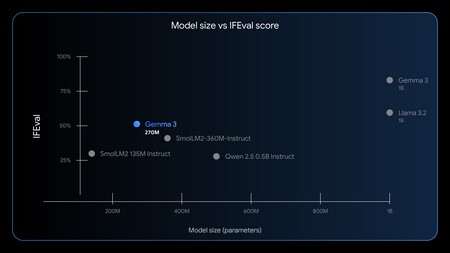
Gemma 3 270M’s performance is impressive despite its size, primarily due to its adaptability for specific tasks.
Adoption Across the Board
Microsoft has similarly invested in small models like Phi-3 and Phi-4, which are tailored for specific applications yet face competition from larger models like GPT-4. Other newer entrants in this space, such as Liquid’s LFM2 model with just 440 million parameters, emphasize the growing interest in compact AI solutions.
Mobile and Wearable Applications
Perhaps one of the most exciting aspects of these smaller models is their feasibility for deployment on mobile devices, smartwatches , and other modest platforms. As highlighted by Google, a quantized version (int4) of Gemma 3 270M can handle 25 conversations with only 0.75% battery usage on a mobile device—a perfect solution for consumers wishing to use AI on the go.
A Promising Horizon
In summary, the emergence of tiny models like Gemma 3 270M is unraveling new possibilities in AI. Rather than merely glossy tools for big tech companies, these models offer a modular approach, catering to specific needs and applications. As we see advancements in fine-tuning techniques , the future of AI seems to lie not in size but rather innovation within manageable frameworks. In this evolving landscape, small might just become the new big.
Image | Amanz