
The Renewable Energy Revolution in Europe: A Summer to Remember
Europe has been on the renewable energy path for several years. This summer has set records in solar energy production, with the installation of massive wind turbines across the continent. While there are some contradictions, such as importing energy from Africa, it is clear that Europe is picking up pace in its transition to renewables. However, this progress is not uniform; some countries lag significantly behind in their reliance on renewable sources for electricity generation.
This disparity is evident in the map created by Visual Capitalist.
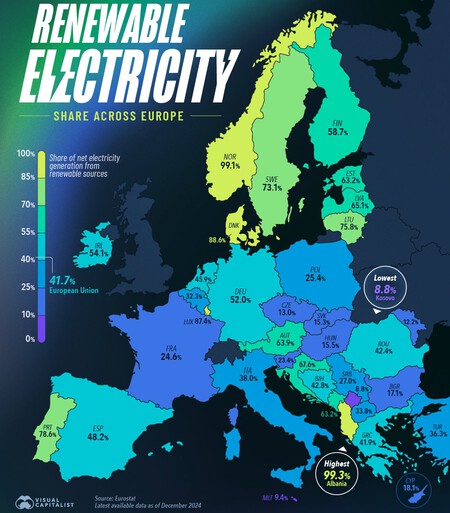
The latest data from Eurostat, available until December 2024, shows a robust trend toward renewables. In fact, energy generation from sources such as wind , solar , hydroelectric , geothermal , and biofuels now exceeds 99% in some countries.
As of December 2024, the European Union derived nearly 42% of its net electricity from renewable sources, with wind and hydroelectric power being critical components of this transition. Interestingly, despite advancements in panel and turbine technology, countries leading in renewables often rely heavily on hydroelectric power.
Notably, Albania tops the list, generating over 99% of its electricity from renewables, closely followed by Norway . In Denmark , which ranks third, wind energy plays the leading role in electricity generation.
On the other hand, some countries like the Czech Republic , Moldova , and Malta continue to struggle with a heavy reliance on fossil fuels. These nations have the lowest proportions of renewable energy in their electricity generation. At the bottom of this list is Kosovo , where only 8.8% of its energy is derived from renewables.
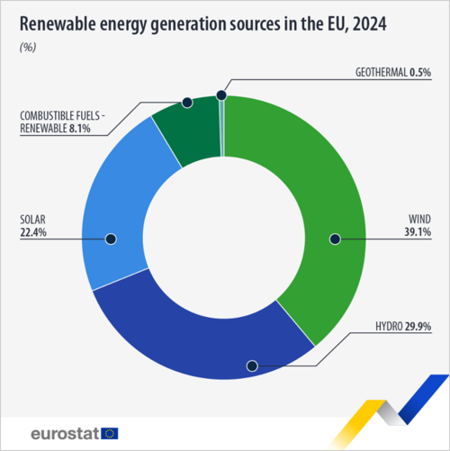
In terms of renewable sources, the contributions vary by country. In Spain , wind energy accounted for 39.1% of its renewable production in 2024; hydroelectric energy followed at 29.9% , and solar power contributed 22.4% . Biofuels and geothermal energy made only marginal contributions of 8.1% and 0.5% , respectively.
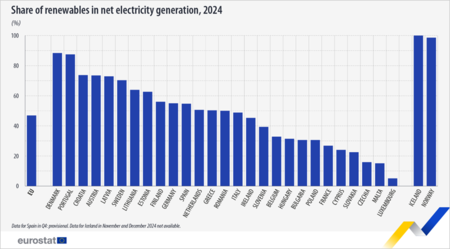
Situation in 2024
Globally, it is a positive trend; over 40% of net energy produced by the EU in 2024 came from renewables. Eurostat data indicates that 47.3% of electric production translates to 1.31 million GW/h , reflecting a 7.7% increase compared to 2023.
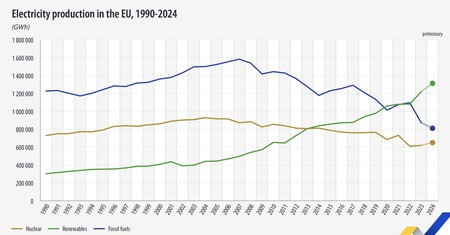
Evolution of energy production during the last 35 years
A report shows that fossil fuel use fell by 7.2% compared to the prior year, almost mirrored by the growth in renewables. Nuclear energy, despite facing challenges, grew by 4.8% .
Looking ahead to 2026, a Eurobarometer survey conducted in June 2025 reveals robust support among EU citizens for the adoption of renewables. Moving forward, the challenge will be determining if this deployment aligns with other ambitious energy needs, such as those required for expanding data centers .
Images | Eurostat
In Xataka | Something is happening with wind energy. Its deployment has stopped while solar energy grows unstoppable.