
The KF-21 has not been designed to impress Washington , nor to compete with the F-35 in rank. It has been designed for something simpler yet more ambitious: that South Korea does not depend on anyone when needing a combat plane. The country is called Boramae , or Hugon Hunter , and it aims to be the axis of its Air defense until 2032 . It is not merely a new generation fighter; it is a symbol , and everything indicates that it will also signal its intent to neighbors.
When South Korea sought to access F-35 technologies to integrate them into their future aircraft, they faced a resounding rejection . The United States denied the transfer of key systems, including Radar Aesa , the electro-optical aiming system ( EOTS ), IRS, and electronic warfare disturbance systems. This episode was decisive. Seoul realized that if it wanted control, it would have to build from scratch. Thus, the KF-21 was born . Through this project, South Korea aims to mark a clear line: there can be no real sovereignty if the most sensitive technologies depend on third parties.
The South Korean Jump Towards Autonomy in Defense
For Seoul, the KF-21 not only satisfies the desire for industrial independence but also fulfills a strategic need . Tensions with North Korea are both cyclical and constant, while China continues to rearm . Meanwhile, Japan is already collaborating with the United Kingdom and Italy on the GCAP —the future sixth-generation fighter projected to fly in 2035. South Korea does not want to be left behind. According to DAPA, the agency overseeing the project, the KF-21 is set to first replace the F-4 and F-5 , and later the F-16 . Having control over one’s own aircraft represents not only a defense strategy but also a means of geopolitical positioning.
According to the government, South Korea became the eighth country to develop a supersonic fighter capable of conducting test flights. The first prototype of the KF-21 was presented in April 2021, and just three months later, on July 19, 2022, it completed its first flight from Sacheon base. Since then, all six planned prototypes are airborne and have surpassed key milestones, including the first supersonic flight (January 2023) and real weapon tests with meteor missiles (May 8, 2024) and Iris-T systems (May 17, 2024) as confirmed by DAPA and Diehl Defense . Deliveries to the Air Force are slated to begin in 2026 .
One of the critical elements of the KF-21 is found within its structure. The Aesa radar installed is developed in South Korea by Hanwha Systems and the Defense Development Agency . Much of the aircraft, including mission systems and sensors, are also domestically produced. According to KAI , the goal is to achieve a 65% nationalization rate in serial production. While the engine is still sourced externally, many systems in the cabin and radar are proudly South Korean.
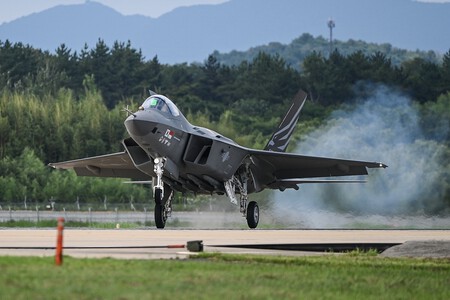
Developing the KF-21 has not been cheap. According to DAPA figures, the initial development budget was set at 8.8 billion Wons , roughly 5.4 billion euros . This funding was structured with 60% contributed by the government, 20% from KAI and local industry partners, and an initial 20% from Indonesia. South Korea has adopted a gradual strategy, focusing on achieving nationalization of components, and not seeking to obtain everything from the outset. They aim to control each phase of the process.
Indonesian participation has been a crucial part of the program, albeit unstable. Initially signed to finance 20% of development, Indonesia stopped payments years later. After much back and forth, in 2025 a new framework was established: Indonesia will contribute about 600,000 million Wons , roughly 415 million euros . This agreement ensures some technological transfers while maintaining access to production for the Indonesian Air Force. South Korea will assume the rest of the costs, indicating that the project continues to forge ahead, albeit not without challenges.
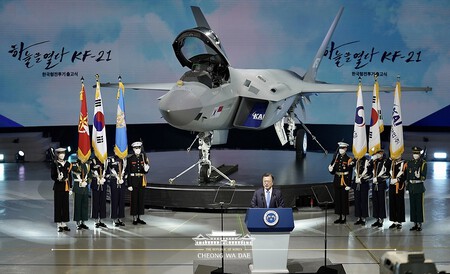
The engine currently represents the primary external dependency of the KF-21. It uses the General Electric F414 , the same engine that powers the F/A-18 Super Hornet, and is assembled under license by Hanwha Aerospace in South Korea. While this arrangement allows for some logistical control, any supply is still contingent upon U.S. authorizations . The South Korean industry is already developing its own engine, but it is not expected to be ready before the next decade. Thus, any export of the KF-21 will remain under ITAR regulations until domestically sourced engines and components become available.
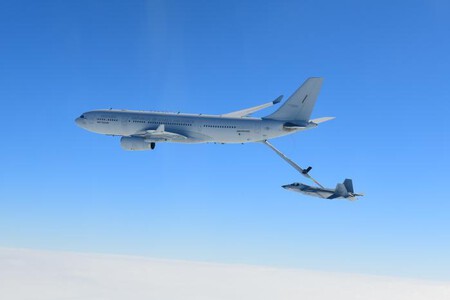
The KF-21 has also been designed with export in mind. South Korea has demonstrated its capability to sell light fighters , such as the FA-50 . Now, it aims to capture a higher market segment with the KF-21. Potential clients include the Philippines and Poland . Additionally, there’s speculation about Egypt , although official confirmation is lacking. The primary limitation remains the American seal on certain components until they can fully domesticize engines and other critical parts.
While the program remains on schedule, challenges persist. The first units to be delivered in 2026 will only be equipped for Air-to-Air engagements, with Air-to-Ground weapon integration planned for 2027 , as confirmed by the Acquisition Programs Council . Additionally, the actual operating costs and field performance remain under evaluation. The South Korean Air Force will directly face these challenges and risks. Although the KF-21 has shown promise in its development, the ultimate test will be its performance in daily operations .
Although it is not yet in service, the KF-21 has already made significant strides: it demonstrates that South Korea does not need to choose between being a mere client or an outsider . Rather, it can evolve into a serious manufacturer . The forthcoming phases—exports, upgrades, and expanding capabilities—will hinge on operational results and the prevailing international landscape. However, the foundational steps have already been successfully accomplished; now it’s time to observe the results unfold.
Images | Korea Government/Ministry of Defense (1, 2, 3, 4, 5) | ANSHMAT | CC by 4.0