
The Advanced European High-Speed Rail Network
Though Japan boasts bullet trains equipped with noise cancellation technology and China showcases futuristic supersonic trains, the European high-speed railway network remains one of the most sophisticated transport infrastructures globally. This network has revolutionized mobility across the continent since France inaugurated its first TGV line in 1981.
Current Infrastructure and Passenger Volume
Today, Europe’s high-speed trains span approximately 65,000 kilometers, catering to around 2.5 billion passengers annually, utilizing about 4,900 trains, as reported by the International Union of Railways (UIC). Understanding this immense figure is far more illuminating when visualized on a detailed map of the continent.
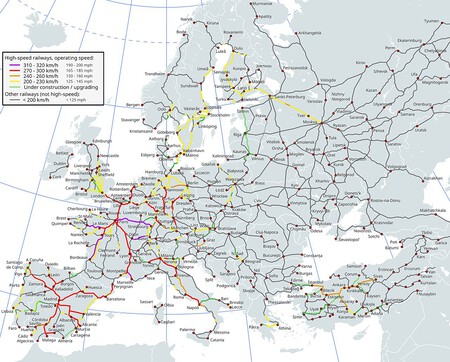
Visualizing Europe’s High-Speed Rail Map
This map of Europe’s high-speed rail network results from the collaborative efforts of Wikimedia Commons users, who regularly update it with projects informed by UIC data. However, beneath the macro data lies a disparity in infrastructure quality across different regions.
Color-Coded Network Details
The provided map uses a color-coding system based on the maximum speed allowed for each segment:
- Pink lines: Maximum high-speed category (310-320 km/h) with advanced infrastructure.
- Red lines: European speed standard (270-300 km/h).
- Yellow and orange lines: Trains reaching 200-260 km/h, typically in topographically challenging areas.
- Dotted green lines: Routes under construction, highlighting future expansion.
Disparity Between Regions
Western Europe, particularly the corridor connecting Spain, France, Germany, and the Benelux countries, showcases the highest density of high-speed rail infrastructure. In contrast, Eastern Europe displays significantly less development. Countries like Poland, the Czech Republic, Hungary, Romania, and the Baltic states have minimal operational high-speed rail, relying instead on slow conventional lines, which limits their competitiveness.
Upcoming Projects
An example of upcoming advancements is the Budapest-Bucharest high-speed project, spanning 590 kilometers, which aims to cut travel time from over 11 hours to approximately 3.5 hours. Set to commence in September 2024, this ambitious project has a budget of about 17 billion euros.
Spain’s High-Speed Leadership
With 3,974 kilometers of operational high-speed rail (as of September 2024), Spain stands out with the largest high-speed network in Europe and the second largest globally, trailing only China. This network continues to expand, characterized by its radial design focused on Madrid and commendable construction efficiency, exhibiting some of the lowest costs per kilometer in comparison to other countries.
Notable Connections and Challenges
High-speed connections like the Eurostar, linking Paris and London in approximately 2 hours and 16 minutes through the Channel Tunnel, highlight the effective international integration of the network. However, significant bottlenecks persist, particularly in mountainous areas and the connections between national networks. Notable projects, like the Brenner Base Tunnel, aim to alleviate these issues, ultimately enhancing connectivity between northern and southern Europe.
Ongoing Challenges and Fragmentation
Despite substantial investments by the EU since 2000, the landscape remains heterogeneous and fragmented. The inability to mandate line construction among member states, combined with diverse signaling systems and technical standards, poses substantial structural challenges for the European high-speed network.
In summary, while Europe’s high-speed rail system stands as a marvel of modern engineering and collaboration, addressing the existing disparities and infrastructural gaps remains crucial for future development.