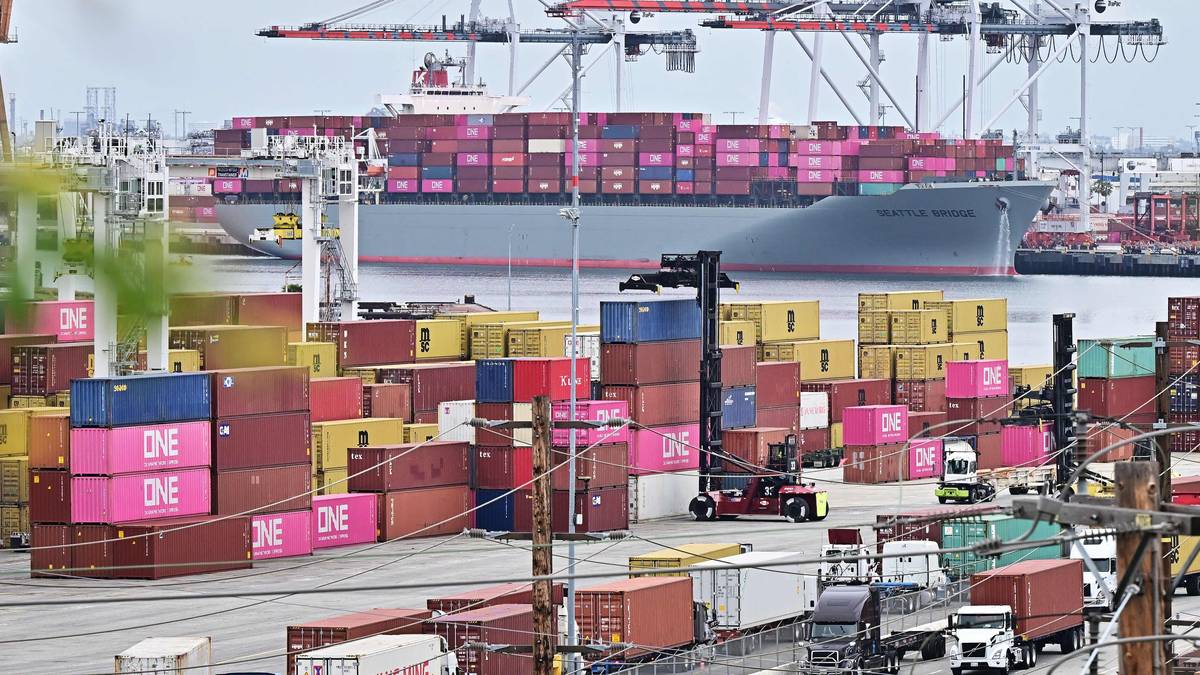
You may not notice it when buying a new phone, jogging pants or a pair of headphones. But before the item ended up on the store shelf, it has been through a global value chain – a journey that starts in Asia, goes through large ports and transit centers, and ends in Europe. If one joint in this chain fails, it propagates further. Right now it is happening in the United States. On the west coast of the United States, the ports of Los Angeles and Long Beach have become the epicenter for the consequences of Donald Trump’s trade war. These are not small ports: The two lie next to the wall and together constitute the United States’ largest entrance for goods from Asia. In a regular month, close to a million containers come from here – filled with everything from electronics to toys, clothing and parts to American factories. But in April, container orders from China fell to the United States by as much as 60 percent. 30 per cent of the Pacific shipping traffic is canceled. The reason is one: Trump’s massive tariff increases, which in many cases have lifted the tariff rates to 145 percent. 417 million reasons for concern Bloomberg recently described the arrival of the container ship Oocl Violet coming to Long Beach with goods worth $ 564 million – loaded before Trump’s announcement. When the ship reached the United States, suddenly 40 percent of the cargo was charged 145 percent. That amounts to $ 417 million – in addition to the existing customs. And Oocl Violet is just one ship. The customs bill not only hits Chinese manufacturers – but also American importers, stores and finally: American consumers. In order to avoid paying customs right away, several importers are now forced to use so -called Bonded Warehouses – customs stocks where you can store goods free of charge for up to five years. It is a kind of financial quarantine: You only pay when the goods are taken out on the market, or never – if they are passed on to another country. Importers who previously only used such stores sporadically are now desperately trying to secure space to avoid immediate tariff load. These bearings act as a kind of “buffer against chaos” – but also as a warning that normal trade streams are about to break down in the meantime, stores have to wait, customers can wait – and businesses can have problems with liquidity. Everything is affected when fewer containers arrive, not only stops the goods. The entire logistical ecosystem around the ports suffers: port workers, truck drivers, warehouse employees, retailers – but also the coffee shops, hairdressers and restaurants that live by people working in the area. Slightly simply: When there is no work at the harbor, there will also be no lunch bookings on the corner. It’s like pulling out a wire in a larger machinery – everything is affected. And it doesn’t stop importing. Exports to China have also collapsed. Orders of American goods – such as soy, grains, oil and semiconductors – are down by over 70 percent. This is a disaster for American farmers and producers who now have to look for new markets at short notice. Propagate everywhere it is easy to think that this is mostly about the United States. But it doesn’t. The value chains are global. When large volumes stop at one end, it propagates to the rest of the world. Increased costs, instability in supplies, changed production lines – this will also be to European companies and consumers. A customs war between the United States and China changes the dynamics throughout world trade. When the world’s largest importer sets up walls overnight, and the world’s largest exporter responds with its, then Norway is not necessarily on safe ground. Trade policy can sound distant and technical. But it’s about how we get what we need – and how we get what we make. When the world’s most important ports stop, it’s not just an American problem. It is also a global notice. Published 08.05.2025, at. 10.42
ttn-69