
In the mid-twentieth century, the United States made a decision that a high-ranking Navy official later described as “the most stupid thing that this country has ever made.” Qian Xuesen, an indisputable genius of aeronautical engineering, co-founder of the prestigious JPL laboratory of NASA, and a key figure in the development of American rocketry, was deported to China in 1955, accused of communist sympathies during a rampant witch hunt.
Qian, welcomed as a hero in his homeland, became the father of China’s space program and the development of ballistic missiles. Decades later, a new generation of Chinese engineers, heirs of the scientific ecosystem that Qian helped build, has shattered a world record with technology that fulfills an old ambition of Qian Xuesen: wind turbines that fly like Zeppelins to harness energy from high-altitude winds.
A Zeppelin Anchored to the Ground to Generate Electricity
On October 10, in the skies above Jingmen, Hubei province, a 23-meter-long aerostat with a dirigible appearance ascended to 500 meters high. This was not a transport or surveillance vehicle, but The S500, a floating wind energy system that began generating more than 50 kilowatts of power at that altitude.
With this flight, China not only launched an innovative project, but also set two world records previously held by an American MIT research team: the highest flight altitude for a similar turbine (the previous record was 297 meters) and the highest power generated (compared to the previous record of 30 kW).
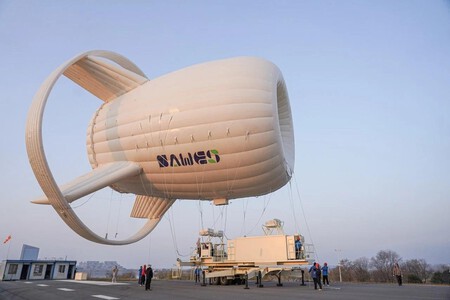
The concept developed by the Sawes company, in collaboration with Tsinghua University and the Chinese Academy of Sciences, is as elegant as it is complex. The system utilizes helium-filled chambers to elevate a wind turbine to altitudes where winds are much stronger and more consistent than at ground level. The electricity generated is transmitted to a ground station through a high-strength cable that also anchors the structure.
The advantage of this design is clear: the energy that can be extracted from the wind is proportional to the cube of its speed. At hundreds of meters high, the winds not only blow faster but are also more stable, significantly reducing the intermittency challenges faced by terrestrial wind farms. According to developer calculations, wind resources in the stratosphere over regions like Hami, Xinjiang, are 40 times greater than those at the surface.
From Emergency Situations to Grid-Scale Generation
The S500 and its successor, the S1000, capable of producing 100 kW, were initially developed for emergency rescues, urban security, and challenging topographical areas. In the event of an earthquake or flood, the system can be deployed rapidly to provide energy and communication solutions in disaster-stricken zones.
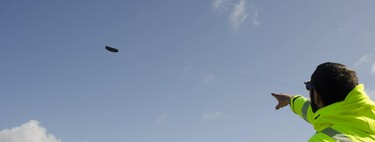
However, Sawes’s ambitions extend far beyond emergency applications. The company recently completed the assembly of the forthcoming model on its roadmap: the S1500, designed to operate at 1,500 meters altitude, representing a significant leap in capacity, with the ability to generate 1 megawatt of power. This advancement indicates that technology is not merely catering to niche areas like emergency response, but is also aiming to become a renewable energy source at a grid scale.
To achieve this power, the S1500 integrates a complex system of 12 generators that operate simultaneously within its central duct. The key to ensuring such a powerful system can ascend lies in material engineering: the generators are made from carbon fiber to minimize weight, keeping the entire structure under a ton.
Similar to its predecessor, energy is converted into electricity within the airship and then transmitted to the ground through an integrated anchoring cable. With this innovative design, Sawes has attracted significant investment, garnering contracts that already exceed 500 million yuan (approximately 64 million euros). The company has established an assembly plant in Yueyang.
The story of Qian Xuesen is one of the most poignant anecdotes about the unintended consequences of fear-driven policies. As documented by the Los Angeles Times, the man who interrogated Wernher Von Braun and laid the foundational work for the JPL was forced to return to a country that, at that time, was experiencing much lower scientific development. He dedicated himself to changing that, and today his successors are materializing some of his visionary ideas in his homeland.
Images | Sawes
In Xataka | How China became a nuclear and spatial power in the most unexpected way: with a student from MIT expelled by the U.S.