
During the Cold War , the possibility of a nuclear attack was far from a remote hypothesis; it was a scenario carefully considered , calculated, and rehearsed. It was estimated that a nuclear explosion in the atmosphere could generate a pulse electromagnetic capable of disabling radars , communications, electrical networks, and command systems. In this context, the United States initiated an ambitious testing program to ensure that its strategic bombers could withstand such threats. They could not afford for an electronic failure to incapacitate a bomber like the B-52. Thus, TRESTLE (Atlas-I) was born, a colossal installation built near Kirtland Air Force Base in New Mexico. Its purpose was as singular as its design: to simulate, without explosives, the effects of a nuclear detonation on real aircraft.
As noted by numerous sources, creating a reliable testing environment required the elimination of any interference. The platform itself had to be rendered ‘invisible’ to the phenomenon it aimed to reproduce. The ingenious solution was to construct the main structure with minimal metal , utilizing laminated wood, fiberglass bolts, and advanced civil engineering techniques. The result resembled a suspended railway bridge over a gorge in the desert. Over 35 meters above the ground, aircraft were towed along a wooden runway and subjected to controlled energy bursts that mimicked the behavior of an electromagnetic pulse . This method recreated, with extreme precision and without nuclear explosions, the invisible effects of a war that must never be fought.
A Colossal Structure to Protect the Core of U.S. Military Power
The mastermind behind the project was Carl E. Baum , a meticulous electrical engineer dedicated to the Air Force for over four decades. He proposed building a non-conductive elevated platform to simulate a realistic flight environment free from interference. His idea was not a hunch but the culmination of years studying the effects of electromagnetic pulses . At a time when computers struggled to accurately model complex phenomena, Baum argued that the only reliable way to understand the impact of an EMP on an airplane was to apply it directly to a real aircraft, avoiding computational shortcuts. He intentionally avoided using computers, though his team utilized them.
Decades later, supercomputers like El Capitan can simulate nuclear explosions in three-dimensional detail with precision unimaginable in the 1970s. However, at that time, neither the calculations nor the models were as sophisticated. Baum preferred to work with a pencil , punched paper, and hand-drawn transparencies. While the world began to imagine defense supported by simulations, he designed a physical environment, assembled almost entirely from wood, to test with real energy what could one day determine a nation’s fate.
Constructing such an installation was not just a matter of size but also of intention. The TRESTLE complex had to be immense but unobtrusive in its experiments. To achieve this, almost all metallic materials were removed from the testing platform; even screws were made from wood or fiberglass. The main table measured around 61 meters on each side , though it was not a perfect square; its corners were cut to improve structural efficiency, slightly reducing its usable area. The entire structure was elevated above a gorge at Kirtland Air Force Base , suspending the aircraft as if they were in-flight. The total length of the complex exceeded 300 meters . Each component was designed to avoid interfering with the reproduction of the phenomenon, although other parts of the installation, such as the Wedge building or the termination tower, were indeed made from steel.
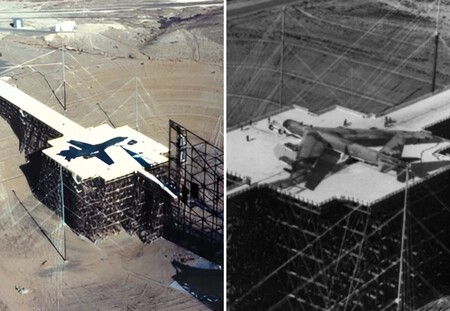
The TRESTLE testing structure in the 1980s
The aircraft were towed to the platform via a 120-meter wooden ramp . Once in position, they were subjected to high-intensity discharges generated by an electrical system capable of faithfully replicating the conditions of a nuclear electromagnetic pulse. Two Marx generators, housed in sealed compartments, emitted pulses of around 5 million volts each . The intention wasn’t to destroy the aircraft but to test how its systems responded to an invisible threat, capable of burning unprotected circuits, with the goal of reinforcing them to remain operational after an actual attack.
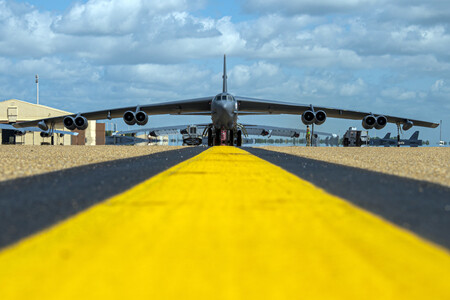
A B-52H Stratofortress at Barksdale Air Force Base, Louisiana (2021)
Throughout the TRESTLE facility, some of the most strategic aircraft in the United States passed through. The B-52 bomber , a symbol of nuclear deterrence, was among the first to undergo testing. This was followed by models like the EC-135 , designed to maintain the command chain in case of crisis, and the E-4 , known as “the doomsday plane.” All shared a critical mission: to remain operational even if the rest of the country were incapacitated. The tests assessed not only the resilience of a circuit or the integrity of a radar but the ability to preserve intact the core of military power in the most unimaginable scenarios.
For decades, TRESTLE was one of the largest wooden structures ever built. Its scale was colossal. To keep it standing, over 60,000 dielectric bolts were used just in the table and ramp, while more than 150,000 special non-metal bolts were employed throughout the installation. This was in addition to millions of laminated wood pieces. Although today, the Grand Ring of the 2025 Expo in Osaka has been officially recognized by Guinness as the world’s largest architectural wooden structure, TRESTLE held that title unofficially for many years.
Images | United States Air Force (Sources: 1, 2, 3, 4, 5)
The legacy of TRESTLE remains a testament to the ingenuity and foresight of military engineers during a time of great uncertainty. This monumental structure not only played a crucial role in understanding the vulnerabilities of military aircraft but also reflected the broader struggle for survival in a world fraught with nuclear threats. As we move further into the future, the lessons learned from TRESTLE echo in today’s defense strategies, reminding us of the delicate balance between technology, power, and the need for vigilance.