
Saturn: A Celestial Marvel Revealed Through Dual Observations
There are images that require no explanation, and Saturn is a prime example. Its iconic rings and majestic appearance make it a focal point of our solar system. The beauty of Saturn captivates astronomers and casual stargazers alike, prompting wonder every time we encounter a new photograph. Recently, NASA provided such a captivating visual by combining observations from the James Webb Space Telescope and the Hubble Space Telescope, showcasing an extraordinary comparison of our celestial neighbor.
A Groundbreaking Comparative View
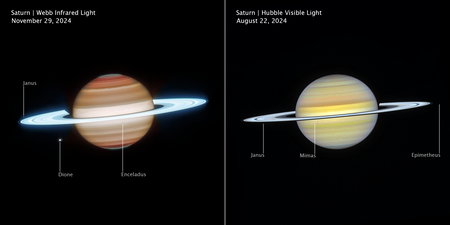
On NASA’s official site, the agency revealed a comparative image that merges two observations: one from Hubble taken on August 22, 2024, and another from James Webb captured on November 29 of the same year. The staggered timing of these images—just 14 weeks apart—provides a unique perspective on how observing at different wavelengths alters our interpretation of Saturn.
Understanding the Visual Differences
At first glance, the differences between the two images are striking. On the left, the James Webb image shows Saturn with deeper, contrasting tones; its rings gleam brightly, revealing their composition of highly reflective water ice. Conversely, the right side showcases Hubble’s view, which is much closer to the appearance we would observe with the naked eye. With softer colors and gentler banding, Hubble’s image mirrors natural perceptions.
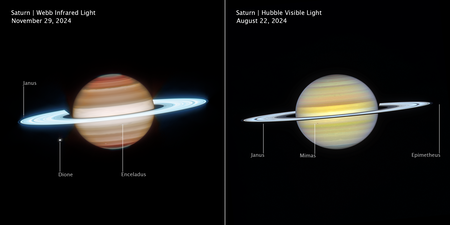
On the left, the image of Saturn captured by the James Webb Space Telescope; On the right, the one obtained by the Hubble Space Telescope: two views that reveal its active atmosphere, its moons and its bright rings.
Unlocking Atmospheric Secrets
This comparison goes beyond mere aesthetics. NASA explains that combining the data from both telescopes enables scientists to study Saturn’s atmosphere at different altitudes, from its deepest clouds to the more tenuous upper regions. In the Webb image, a long-lasting jet stream known as a “ribbon wave” is visible, along with the remnants of a significant storm from 2010-2012. Meanwhile, Hubble provides ongoing analysis, tracking the planet’s bands and evolving patterns over time.
The Science of Light Observation
It’s crucial to understand the fundamental differences in how these images are generated. Hubble captures light in the visible spectrum—meaning its images resemble what we would naturally perceive with our eyes. James Webb, conversely, observes wavelengths in the infrared spectrum, which are imperceptible to us. This enables the detection of different atmospheric phenomena, allowing scientists to interpret data through translated visible colors, resulting in the vivid yet unnatural tones for which Webb’s images are known.
Conclusion: Beyond the Dual Perspectives
If you were to choose a single image to represent Saturn, Hubble’s would likely be it—offering a more “familiar” view of the planet. However, the value lies not in selecting one over the other but in recognizing what each telescope contributes. Webb’s infrared insights shine a light on atmospheric processes that might otherwise remain concealed, demonstrating that by combining these two perspectives, we gain a far richer understanding of Saturn. This captivating duality adds layers to our appreciation of one of the solar system’s most stunning planets.