
The Crucial Role of Maritime Transport in Global Oil Supply
In the intricate mosaic of the global supply chain , it’s easy to assume that air and rail transport reign supreme due to their speed and efficiency. Yet, when it comes to the overwhelming volume of oil transport, the humble ship continues to dominate, silently but effectively carrying the lifeblood of the global economy. While innovations like China’s ambitious new ‘Silk Route’ gain attention, the maritime routes leading from key oil-producing countries remain paramount, especially among oil’s pivotal chokepoints.
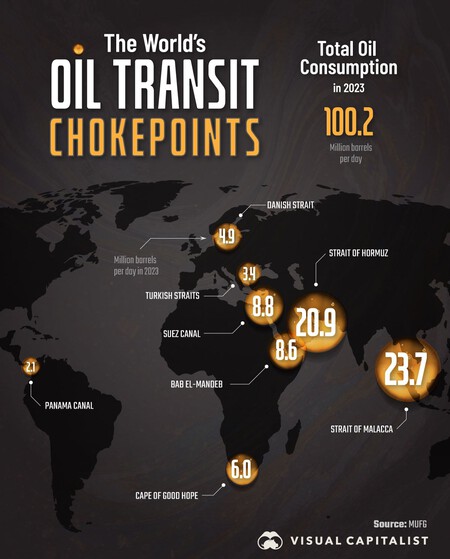
Astonishingly, the transport of oil worldwide revolves around specific choke points that are akin to arteries in a circulatory system. This graph prepared by Visual Capitalist illustrates this phenomenon effectively.
Understanding the Data. Discussing oil often leads to conversations about countries that hold massive reserves. Notably, the country with the largest reserves— Venezuela —is not the top producer. The world oil trade is funneled through select points between Asia and the Middle East. If these chokepoints encounter issues, global oil supply and economies will feel the repercussions.
Consider the staggering amounts involved; every day, millions of barrels traverse these crucial maritime routes. Take a look at these estimated daily movements:
Millions of barrels a day in 2023 | |
|---|---|
Strait of Malaca | 23.7 |
Ormuz Strait | 20.9 |
Suez Canal | 8.8 |
Bab el-Mandeb | 8.6 |
Cape of Good Hope | 6 |
Strait of Denmark | 4.9 |
Strait of Türkiye | 3.4 |
Panama Canal | 2.1 |
Strait of Malaca: The Major Funnel. The Strait of Malaca , with a transit of 23.7 million barrels daily in 2023, is unmistakably one of the most crucial corridors for oil transport. This vital route facilitates oil transportation from the Middle East to key importers in Asia, namely Japan , South Korea , and *especially* China . It serves as a vital link between the Indian and Pacific Oceans, solidifying Singapore’s position as the largest maritime refueling station.
As the top importer of oil , China plays a critical role in global demand. Approximately 25% of maritime oil transportation occurs through this corridor, emphasizing its strategic importance.
Ormuz: The Hot Spot. While the Malaca Strait is essential for oil heading to Asia, the Strait of Ormuz is the lifeline for oil from major producers like Saudi Arabia and Iraq . This corridor, which is only 40 kilometers wide and 167 kilometers long, is not only significant for oil but also for liquefied natural gas. Approximately 20% of oil output globally pass through here.
Because of its unique characteristics, the Ormuz Strait allows the passage of huge oil tankers. Unfortunately, its geopolitical significance has also made it a hotspot for diplomatic tensions involving Iran , Israel , and the United States .
A Fragile Balance. Any disruption in oil flow through Ormuz could significantly impact global economies. Historical fluctuations akin to those seen after the Ukraine War or during the 1970s oil crisis are possible. Other chokepoints would likely become overcrowded, thus creating longer shipping times and exacerbating pricing issues.
Despite several key global oil chokepoints, it’s vital to note that Malaca and Ormuz handle nearly half of the total crude oil movement worldwide. This means that geopolitical tensions can easily destabilize the already fragile balance.

In response to rising tensions, Saudi Arabia and the United Arab Emirates are actively working on pipelines that diversify oil transport routes. Similarly, the ‘New Silk Route’ seeks to mitigate reliance on these crucial maritime paths. Nevertheless, for now, the Strait of Malaca and the Strait of Ormuz hold critical positions in global oil trade, and any disruptions could send shockwaves through the worldwide economy.