

Current Economic Projections for Argentina
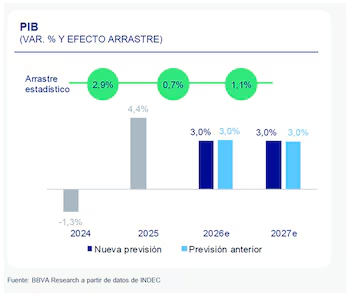
The Argentine macroeconomic outlook for the next two years reflects a stabilization process, albeit one that is slower than government forecasts suggest. According to BBVA Research’s latest report, “Argentine Situation” from March 2026, the country’s Gross Domestic Product (GDP) is projected to grow by 3.0% in both 2026 and 2027, following a notable rebound of 4.4% in 2025. This would mark three consecutive years of growth, a feat not accomplished in two decades. However, BBVA’s estimates fall short of the government’s 5% GDP growth target for 2026.
Inflation Forecasts
BBVA anticipates a significant reduction in inflation rates. Ending 2025 with an inflation rate of 31.5%, the forecast suggests a decline to 24.0% in 2026, eventually reaching 15.0% by 2027. This outlook is expected to be supported by a more stable fiscal policy, monetary prudence, and enhanced exchange rate flexibility. However, previous estimates suggested an inflation rate of just 14% for 2026, indicating a recent deterioration in expectations.
Key Growth Sectors
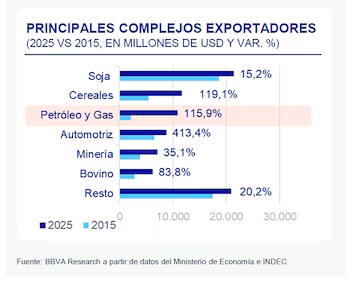
Growth during 2026-2027 will not be uniform but will be notably driven by sectors with robust export capacity, particularly in energy, mining, and agriculture. The energy sector, accounting for 12.5% of total exports, is positioned as a crucial component for sustainable economic expansion. The report emphasizes that these tradable sectors will help mitigate slower growth in other parts of the economy.
Fiscal Discipline and Monetary Policy
Maintaining fiscal discipline is central to Argentina’s financial health. The country is in its second year of achieving a fiscal surplus, with BBVA projecting a primary fiscal result of 1.5% of GDP for the years 2026 and 2027. On the monetary front, expectations are for disinflation due to consistent fiscal and monetary policies. The projected monetary policy rate is 20.0% by the end of 2026, decreasing to 17.0% by the year’s end in 2027.
Geopolitical Risks and External Factors
The international climate, influenced by geopolitical conflicts such as the one in Iran, poses a mix of risks for the Argentine economy. While global uncertainty remains, Argentina’s exposure to direct repercussions is deemed limited. An increase in international fuel prices could benefit trade balances but might add pressure to local inflation rates.
Labor Market Perspectives and Social Challenges
Despite growth projections, the labor market remains a major social concern. The unemployment rate rose to 7.5% in 2025. However, BBVA forecasts a gradual decrease to 6.9% in 2026 and further to 6.2% by 2027, aided by the new Labor Modernization Law aimed at enhancing employment quality.
Credit Market Outlook
In terms of credit, BBVA warns of rising delinquency rates among household loans, which have surged from 2.67% in January 2025 to 10.6% by January 2026. However, stabilization is expected by the latter half of 2026, coinciding with a recovery of real wages and the disinflation trend.