

The Launch of GPT-5: Expectations vs. Reality
The launch of GPT-5 has generated a wave of anticipation and speculation. Dubbed as a potential game-changer in artificial intelligence, many expected a monumental leap from its predecessor, GPT-4. However, the early feedback has been somewhat disappointing, with critics mentioning that while it indeed shows improvements, they are not as remarkable as expected.
Corporations Embrace GPT-5
Despite initial criticisms, it appears that companies are increasingly adopting GPT-5 into their operations. Major players such as Cursor, Vercel, Jetbrains, and Factory have integrated GPT-5 as their default model due to its ability to deliver quicker and more reliable results in complex tasks. In a statement to CNBC, Aaron Levi, the CEO of Box, characterized GPT-5 as “a great advance” that displays a level of reasoning unmatched by other models, reaffirming the model’s potential in real-world applications.
The Buzz and the Reality
The enthusiastic statements from executives at these companies contribute to a positive narrative at launch time, yet the dynamics of business alliances often encourage such mutual support. These companies remain agnostic to many AI models, serving as intermediaries that help users choose platforms that best suit their needs for performance and cost-efficiency. For instance, Cursor permits the utilization of multiple AI models, including Claude Opus 4.1 alongside GPT-5, allowing users to navigate between different options depending on their specific requirements.
Anthropic: Facing Challenges
The primary competitor facing challenges from GPT-5 is Anthropic, which previously enjoyed a significant stature within the business sector. Historically, Anthropic’s chatbot, Claude, was the preferred choice due to its strong performance in programming and interface design. As per a Menlo Ventures study, Claude had commanded a 32% market share compared to OpenAI’s 25%.
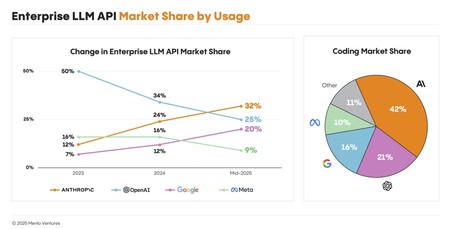

Source: Menlo Ventures.
With 80% of Anthropic’s revenue stemming from corporate use of Claude, the implications of GPT-5’s advantages could significantly impact its financial stability. The company’s annual revenue is projected to grow dramatically, hitting 17 times that of 2024, with over $3 billion secured in the last six months alone.
Cost Dynamics Favor OpenAI
One vital factor that sets GPT-5 apart is its cost. Reports indicate that it can be up to 7.5 times cheaper than Claude Opus 4.1, making it highly attractive for enterprise users. This reduced cost can catalyze a broader adoption in enterprise settings, thus amplifying OpenAI’s visibility and market share.
However, there is a caveat: while GPT-5’s pricing appears favorable, it is crucial to consider the total cost of ownership, which may shift when intermediate reasoning steps are factored in. Although it is marketed as a more cost-effective solution, the indirect charges could potentially offset the apparent savings.
The Rise of Reasoning Models in Business
The pronounced success of GPT-5 can largely be attributed to advancements in its reasoning capabilities. According to benchmarks, the ability to perform complex reasoning has increased its usage by a factor of eight among corporate clients. As companies favor models that exhibit precise reasoning—despite their higher costs—GPT-5 is beginning to carve out a niche in the market.
OpenAI’s Strategy Amidst Competition
In response to these competitive challenges, OpenAI has bolstered its sales efforts, expanding its dedicated sales team to over 500 professionals. This move, occurring independently of its collaboration with Microsoft, seeks to secure more business clients while tackling rising infrastructure costs that accompany increased model usage. OpenAI is reportedly facing expenses nearing $8 billion this fiscal year, highlighting the need for a sustainable revenue model in an increasingly competitive landscape.
In conclusion, the launch of GPT-5 has not lived up to the lofty expectations set by enthusiasts and industry experts alike. However, its ability to secure significant corporate partnerships and bolster reasoning capabilities positions it favorably in the competitive AI landscape. OpenAI’s efforts to improve its outreach and sales strategies may also pave the way for a more resilient future as it navigates the challenges posed by competitors like Anthropic.