
The Changing Landscape of Search Engine Agreements: Google and Apple
The most profitable agreement in technological history has just changed its rules of the game. Google will be able to continue paying Apple for being the predetermined search engine in Safari, but it will no longer be able to shield that position with an exclusivity contract .
Why is it important? Judge Amit Mehta has allowed Google to continue its payments to Apple and other distribution partners but with a fundamental condition: they will not be able to condition those payments to exclusivity . The company may pay to appear pre-installed, but it will not be able to prevent its competitors from doing the same.
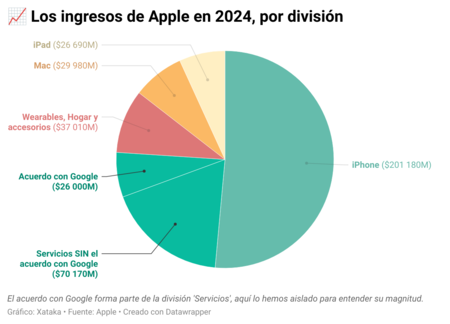
In figures. Google pays more than $26 billion a year for these distribution agreements, with Apple as the main beneficiary.
- For Google, it is an investment that is worth it: about 40% of its searches in the United States arrive through Safari. The agreement serves as a deterrent so that Apple does not launch its own search engine.
- For Apple, it represents practically pure income that is direct to its results account.
New rules. Apple is now in a privileged position. It can keep Google as a predetermined option if it is still the one who pays best, but it can also offer that position to Microsoft with Bing , Perplexity , or even several search engines at the same time. This change transforms a forced marriage into an open market.
Smartphone manufacturers are now free to preinstall or promote other search engines alongside Google’s. For instance, Samsung could prominently feature Bing as an alternative, while Mozilla could diversify its options in Firefox.

Between the lines. The judge’s decision indicates a concern for the future rather than the past. Mehta repeatedly mentions the emergence of generative AI and how ChatGPT has altered the competitive landscape. He has been cautious about intervening in a market that is being “rapidly transformed” by new players.
This caution has saved Google from more devastating repercussions. The judge initially considered a forced sale of Chrome and significantly stricter limitations, but deemed such actions “very complicated and risky.”
- The market celebrated the decision, with shares in Google rising by 8% and in Apple by 4% .
Turning point. This ruling marks the dawn of a new era in the distribution of search engines. Apple can now experiment with hybrid models:
- Google for general searches.
- Perplexity for AI inquiries.
- Specialized search engines for specific niches.
Or simply opt for whoever pays the highest at any moment.
The threat. For Google, the risk is not solely losing exclusivity but also facing a permanent auction for search engine prominence.
- If Microsoft decides to invest heavily to capture Safari, the costs could soar.
- Additionally, if Apple chooses to diversify its options, Google may lose control over an essential portion of its traffic.
The true winner of this ruling is not Google, who has avoided fragmentation but weakened its stronghold. It is Apple, who maintains its substantial income while gaining the flexibility to select the best contractor at any given time.
Tim Cook has witnessed his most lucrative business become even more valuable.
Update: Google, in an official statement, emphasized that the Court “acknowledged that divesting Chrome and Android would have exceeded the focus of the case” and would have harmed consumers and partners. The company maintains that “the competition is intense” and expresses concerns about how data sharing “will impact our users and their privacy.”
This is the full statement:
“Today’s decision recognizes how much the industry has changed with the arrival of AI, giving people many more ways to find information. This reinforces our stance since the case was initiated in 2020: the competition is fierce, and users can easily choose the services they prefer. Therefore, we strongly disagree with the initial ruling of the court in August 2024 regarding responsibility.
Now the court has imposed restrictions on how we distribute Google’s services and will require us to share search data with rivals. We are concerned about how these stipulations will affect our users and their privacy, and we are reviewing the decision closely. The Court recognized that divesting Chrome and Android would have gone beyond the focus of the distribution case and would have harmed consumers and our partners.”
“As always, we will continue focusing on what truly matters: building innovative products that people choose and love.”
In Xataka | Browsers prepare for the most radical transformation in their history, in which AI will play a pivotal role.
Outstanding image credits: Solen Feyissa