
Google Cloud Next 2026: A New Era for AI
The recent keynote at Google Cloud Next 2026, held in Las Vegas, marked a pivotal transition in the realm of artificial intelligence within corporate structures. Hosted by Thomas Kurian and featuring a video address from Google CEO Sundar Pichai, the event revealed groundbreaking advancements that indicate the end of experimental phases in AI deployment.
AI Integration in Coding
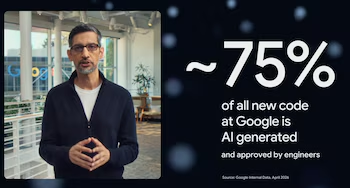
Google’s statistics are staggering: 75% of new code at Google is now generated by AI, a significant increase from 50% just one year prior. This exponential growth signifies a transition from pilot testing to practical implementation, reshaping how companies approach software development. Pichai illustrated this with a case study showing that tasks which previously required weeks of manpower could now be completed up to six times faster by AI agents.
The Role of AI Agents
These AI agents, conceptualized as a digital workforce, have three distinct roles—planners, orchestrators, and programmers. This shift introduces a collaborative environment where AI does not merely assist humans but actively contributes to coding processes and operational efficiency.
The Gemini Enterprise Agent Platform
Central to this transformation is the Gemini Enterprise Agent Platform. Kurian referred to it as the “connective tissue” enabling seamless integration of AI into business structures. Unlike other platforms, it provides a singular solution rather than fragmented parts, emphasizing Google’s approach to delivering a coherent technology stack.
Real-World Applications
The practical implications of these advancements are already observable. For instance, KPMG has reported a 90% adoption rate of the Gemini platform among its workforce, showcasing the platform’s potential for enhancing productivity. Similarly, companies like Signal Iduna and Walmart have noted substantial improvements in customer response times and operational efficiencies, respectively.
API Innovations: Making Integration Simpler
During the event, Google showcased the Interactions API, which streamlines the process of calling various models and agents. This allows companies to integrate complex AI functionalities into their existing systems with minimal effort. Pichai emphasized how this shift transforms the landscape, reducing the time needed for developing AI capabilities from months to mere minutes.
Looking Ahead: The Future of AI in Business
The advances presented during Google Cloud Next 2026 are indicative of a broader industry trend. The newly announced tools and capabilities shift the focus from pilot projects to full-scale deployments, utilizing fleets of autonomous AI agents performing complex tasks.
In conclusion, Google has not only enhanced its technological offerings but has also provided the infrastructure for other companies to leverage AI effectively. As we stand on the threshold of this new era, businesses must contemplate how to incorporate these innovations into their operational frameworks for future success.