
Germany’s Innovative Recycling of 17th Century Bullets for Solar Energy
In the ongoing energy transition, solar energy has emerged as a leading contender in renewable technologies. From expansive fields in Spain to arid deserts and even floating on lakes, solar parks are proliferating globally. While crystallized silicon has been the predominant technology, perovskite solar cells are quickly gaining attention for their notable efficiency, boasting laboratory-certified rates of up to 26%.
The Challenge of Lead Iodide Supply
Despite the promise of perovskite technology, scaling it for large-scale deployment poses significant challenges. A primary obstacle is the sustainable supply of high-purity lead iodide, which is essential for the performance of perovskite solar cells. Lead, known for its toxicity, presents a dilemma; mining it is unsustainable, and existing recycling processes fall short of meeting purity standards.
Revolutionary Upcycling Technique
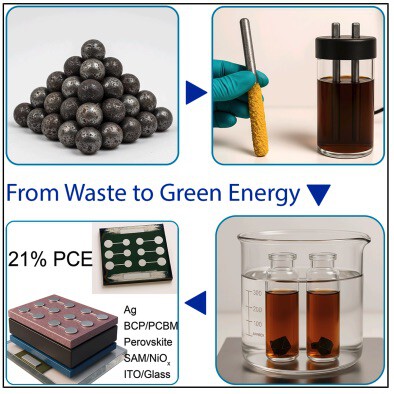
Recently, a German research team at the Helmholtz Institute in Erlangen-Nuremberg made headlines by transforming 17th-century musket balls into lead iodide suitable for solar cells. Their innovative approach, involving an upcycling process that combines non-aqueous electrochemical routes and crystallization, diverges from traditional recycling methods that rely on harsh chemicals and large volumes of water.
Substantial Findings from Historical Materials
Using lead from historical bullets, the team overcame complications posed by carbon residues, metal inclusions, and oxidation patina. If this method can purify such complex materials, it raises hope for processing even lower-quality lead waste, resulting in a promising solution for future recycling efforts.
Importance of This Research
The team successfully manufactured perovskite solar cells from their recycled lead iodide, achieving an efficiency of 21%. This is nearly on par with the 22% efficiency of cells made from industrially synthesized lead iodide. Beyond its technical implications, this breakthrough simultaneously addresses two critical issues: it provides an alternative supply of lead iodide while also mitigating the environmental impact associated with mining and managing lead waste.
Contextual Challenges in Lead Recycling
Lead waste is abundant, sourced from various sectors, including used car batteries and electronics. However, current recovery rates remain low—only about 48% in 2018. Conventional recycling processes yield lead suitable for batteries but do not meet the ultra-purity standards required for solar applications. Furthermore, these methods can produce toxic gases and entail high costs.
Details of the New Process
The innovative approach involves cleaning the bullets using dilute nitric acid before melting them into rods that serve as electrodes in an electrochemical cell filled with acetonitrile and iodine. When an electric current is applied, lead reacts with iodine, generating lead iodide with an impressive 94% efficiency. To further purify this lead iodide, a controlled crystallization process lasting around 70 hours is employed, expelling impurities like silver or copper and enhancing purity levels.
Challenges Ahead for Industrial Application
Despite the promising results at a laboratory scale, scalability remains a significant hurdle. Currently, the process yields just 0.05 grams of lead iodide per hour, and the complexity of organic solvent recovery and electrode maintenance needs addressing for industrial applications to flourish. As the research team acknowledges, while their chemistry is validated, transitioning from the lab to actual production will determine whether perovskite panels utilizing recycled lead become a reality.
Germany’s innovative endeavor of recycling historical lead into renewable energy sources signifies a potential game-changer in the quest for sustainable energy solutions, pushing us closer to an era where waste contributes positively to our energy future.