
State of Emergency in Perú: An Overview
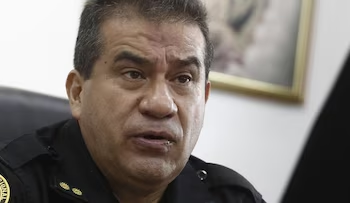
It’s been over a month since the government of José Jerí declared a state of emergency in Lima Metropolitana and Callao. While this measure aims to combat rising insecurity, both the president and the National Police of Peru have yet to provide a comprehensive assessment of its effectiveness. Despite this, PNP General Commander Óscar Arriola has labeled the results as “enormous.”
Lack of Specific Data
General Arriola’s assertions have drawn skepticism, particularly due to the absence of concrete data to substantiate his claims. During an interview with RPP, he highlighted successes mirrored in Chile, Ecuador, and Colombia but failed to provide detailed figures or specific operational outcomes related to the state of emergency.
He stated, “I categorically emphasize, the results are enormous,” referring to multiple factors, including the number of arrests, seizures of explosives, and the incarceration of foreign criminals, particularly Venezuelans. However, he refrained from discussing precise numbers or statistics.
The Call for Accountability
When pressed about the state of emergency figures, General Arriola reiterated that the results “are enormous” but maintained that they still need to be reviewed. Unfortunately, no clear timeline has been established for when these results will be made publicly available. This lack of transparency raises critical questions about the efficacy and true impact of the measures in place.
When Will We Know the Results?
General Arriola was questioned during the same interview about when the outcomes of the Lima and Callao state of emergency would be presented. His vague response pointed to President José Jerí, who had previously promised results by October 27. To date, this promise remains unfulfilled.
The general downplayed the situation, stating he was too fatigued to delve into political matters, asserting, “I’m a policeman, nothing more.” This statement raises concerns about the leadership and accountability within the PNP regarding public safety measures.
Controversial Stance on Human Rights
General Arriola recently caused a stir by accusing NGOs advocating for human rights of “destabilizing and lowering morale” within the National Police. He suggested these organizations might be financially backed by uncertain sources and stated, “Our hands are not going to shake; we prefer to go to jail, but act with a heavy hand.” This comment illustrates a hardline approach, emphasizing a commitment to fight crime aggressively, even in the face of potential legal ramifications.
Moreover, Arriola underscored that current laws permit police officers to use lethal force against criminals wielding firearms, urging a proportional response to criminal violence. This aggressive stance raises questions about the balance between lawful policing and potential human rights violations.
Conclusion
As the situation evolves in Peru, the lack of clarity regarding the results of the state of emergency, combined with aggressive law enforcement strategies, emphasizes the need for transparency and accountability in the fight against crime. Both the public and policymakers are left waiting for actionable insights and a clear path forward.