
The Rift Between Donald Trump and Pope Leo XIV: A Step-by-Step Analysis
Escalating Tensions
The recent clash between President Donald Trump and Pope Leo XIV is not a mere spat; rather, it represents the culmination of ongoing tensions that have been brewing for over a year. A backdrop of geopolitical strife, particularly the unfolding conflict with Iran, coupled with a clandestine meeting at the Pentagon, has brought to light a deeper ideological struggle: who has the authority to invoke God to justify power.
The Immediate Trigger
The situation intensified during a prayer vigil held by the Pope on April 11 at St. Peter’s Basilica. Here, Leo XIV, the first American-born pontiff, denounced the “delusion of omnipotence” that fuels wars and firmly rejected any attempts to “recruit God” to justify the killing of civilians. Although he did not mention Trump directly, the implications were clear. This followed weeks after Trump threatened to “destroy an entire civilization” in Iran, while his Secretary of Defense, Pete Hegseth, urged the American public to pray for victory “in the name of Jesus Christ.”
Response from the President
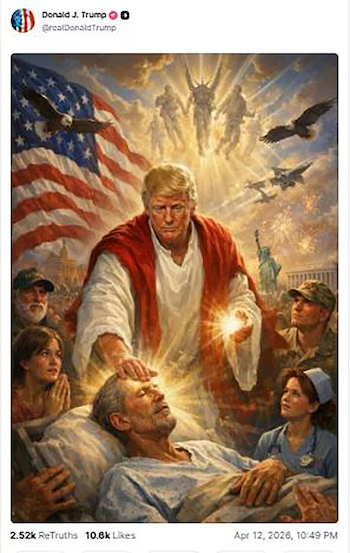
Shortly after the Pope’s remarks, Trump retaliated on social media, declaring Leo XIV “WEAK on security and terrible on foreign policy.” Trump further distanced himself by stating, “I’m not a fan of Pope Leo,” which he emphasized to reporters upon arriving in Washington. That very night, he shared an image of himself depicted in biblical garments, casting himself as a messianic figure.
The Pope’s Firm Counter
In response, the Pope remained resolute. Speaking from his plane en route to Algeria, he declared, “I am not afraid of the Trump administration,” defending his position on peace as a fundamental element of the Gospel, rather than a political critique.
Broken from the Start: A Closer Examination
Leo XIV’s papacy, initially thought to symbolize a bridge between the Catholic Church and the Trump administration, has been marred by rising tensions almost since its inception in May 2025. While some in Washington expected a cooperative relationship, the Pope’s stance on numerous issues diverged starkly from the administration’s policies.
Key Issues Leading to Tension
- Immigration Policies: Leo XIV expressed concerns about the administration’s harsh immigration policies, which clashed with the growing discontent among American bishops regarding mass deportations.
- Declining an Invitation: Leo XIV chose not to attend a celebration of America’s 250th anniversary at the White House, opting instead to spend Independence Day on the island of Lampedusa, a symbolic gesture highlighting the plight of African migrants.
The Pentagon Meeting: A Pivotal Moment
A significant turning point occurred in January 2026, during a historic meeting where Cardinal Christophe Pierre, the Vatican ambassador to the U.S., faced a “bitter lesson” from U.S. officials about its military might. According to Vatican sources, officials warned that the Church should align more closely with U.S. interests, drawing unsettling parallels with the Papacy of Avignon.
Insisting on Moral Authority
Following the meeting, tensions escalated rapidly. When Trump threatened military action against Iran, Leo XIV labeled such threats “truly unacceptable.” He subsequently urged Americans to advocate against escalating violence, an unprecedented action for a modern pontiff, during his prayer vigil at St. Peter’s Basilica.
Conclusion: A Battle for Moral Legitimacy
The developing conflict can be viewed as a struggle between two visions of power: Trump’s desire for religious endorsement of his policies and Leo XIV’s commitment to a moral call for peace. Trump accused the Pope of being “weak on crime” and playing into the hands of the “radical left,” while Leo XIV pointed out that the true message of the Gospel is, “Blessed are those who work for peace.”
Ultimately, as Leo XIV emphasized with his firm statement, “I am not afraid of the Trump administration,” this exchange marks a significant chapter in a contentious relationship that reveals contrasting ideologies concerning faith and governance.