
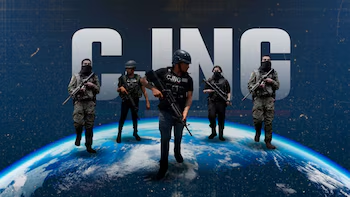
The Impact of El Mencho’s Death on CJNG
The death of Nemesio Oseguera Cervantes, widely known as “El Mencho,” is poised to reshape not just the dynamics within the Jalisco New Generation Cartel (CJNG), but also its influence on the international drug trade. Following a military operation on February 22, which resulted in the deaths of several individuals across more than 20 Mexican states, the group’s stability is now in question.
Fragmentation and Turmoil
El Mencho’s absence signals potential fragmentation and new disputes both inside Mexico and on international fronts. Various regional and international players are likely to vie for a share of CJNG’s previously controlled territories and drug routes. Geopolitical analyst Stephanie Henaro asserts that previous eliminations of criminal leaders have historically led to violent territorial disputes, as seen with the Millennium Cartel, which ultimately birthed CJNG.
CJNG’s Global Criminal Landscape
Mexican drug trafficking has evolved significantly since its inception in the 1920s. Initially confined to isolated enclaves, it grew to become a dominant player in the global drug trade. Henaro explains that every time a criminal boss falls, territorial fragmentation occurs. The power vacuum following El Mencho’s death could prompt multiple factions to emerge, seeking to establish dominance in lucrative territories.
Global Players Eye CJNG’s Territories
As the CJNG struggles internally, the First Capital Command (PCC) of Brazil emerges as a significant contender for control of the lucrative drug routes and markets in Latin America. With roots in São Paulo, the PCC has transitioned from a local prison-based entity to a formidable transnational network involved in drug production and synthetic drug trafficking. It has established collaborations with CJNG and the Sinaloa Cartel, highlighting a complex web of alliances.
Los Cuinis: A Financial Powerhouse
The González Valencia family, known as Los Cuinis, acts as the financial arm of CJNG, operating in Argentina, Uruguay, and Bolivia. This family’s strategic maneuvers have included using front companies and offshore accounts for money laundering. Their ability to navigate different countries makes them a vital player in the cartels’ international expansion.
Potential Outcomes in Europe
El Mencho’s death may inadvertently bolster the Mocro Maffia, a criminal network of Moroccan-Dutch origin centered in the Netherlands and Belgium. This group controls a substantial portion of cocaine traffic entering Europe, forming critical alliances with both CJNG and the Sinaloa Cartel. The Mocro Maffia employs extreme violence, evidenced by high-profile murders, to reinforce their power in the drug trade.
Future of Drug Trade Dynamics
As the landscape shifts, it is crucial to monitor five strategic regions within Mexico that could become flashpoints for violence and territorial struggles. These key areas include:
- Western Pacific (Sinaloa, Jalisco, Michoacán, Colima): Vital for the production and export of synthetic drugs.
- Bajío Industrial (Guanajuato, Querétaro): A logistical hub connected by pipelines and highways.
- Northwest Border (Tamaulipas, Nuevo León): Critical for cross-border drug transfer.
- Mexican Caribbean (Quintana Roo, Yucatán): Offers alternative trafficking routes.
- Atlantic: A potential target for the PCC’s expansionist ambitions.
Each of these regions represents both opportunity and conflict, setting the stage for the next chapter in Mexican drug trafficking.