
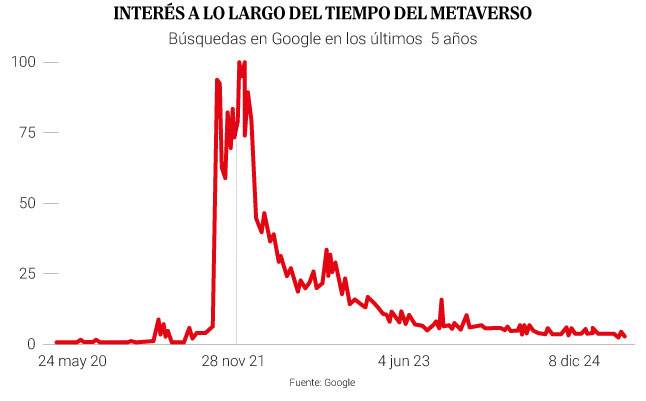
On October 28, 2021, Mark Zuckerberg , the creator of Facebook and then CEO of the company, announced “the next chapter of the internet”: the metaverse . The magnitude of this move prompted Facebook to rebrand as Meta . “First is going to be the metaverse, not Facebook,” Zuckerberg proclaimed. This announcement sent shockwaves through the tech industry, prompting thousands of companies to jump on the metaverse bandwagon. Today, while the metaverse hasn’t completely derailed, it hasn’t quite reached the anticipated destination either. There appears to be a metabubble inflating and deflating, as the tech world shifts its focus towards the burgeoning field of artificial intelligence . Experts argue that it’s too early to write off the metaverse, although they believe it will evolve into something markedly different from Zuckerberg’s initial vision.
Many companies joined this fervor for the metaverse, with Telefónica even designating a Chief Metaverse Officer, Yaiza Rubio , to lead their project initiatives. Others, including giants like H&M , Adidas , and Louis Vuitton , began offering their products within the metaverse. Meanwhile, other firms took a more physical approach, launching virtual reality (VR) headsets that theoretically could allow users to explore these metaverses. Companies like Microsoft with HoloLens , HTC with Vive Pro , and Apple with Vision Pro , whose price point hovers around €3,500, have also entered the arena. However, several companies have since faded from the scene.
As technology analyst Antonio Ortiz recalls, “Many made headsets; all those who thought they would be a consumer gadget.” However, as soon as traction was lacking, many withdrew from the race. Notably, smaller companies often showed greater enthusiasm in their pursuit of becoming the metaverse reference point, driven by the promise of substantial economic gain.
In this rush, many companies focused on cryptocurrency —a concept tightly linked to virtual goods in the metaverse via blockchain technology and NFTs (non-fungible tokens) . These crypto firms launched projects creating metaverses, virtual shops, clothing, and a variety of collectible items. Silvia Leal , an advisor to the OECD , reminisces about early metaverses, which resembled basic 3D environments with minimal engaging experiences. “It was absurd; the immersive experiences were dreadful; any amateur video game was far superior,” she asserts.
“Almost any 3D world with permanent elements began to be labeled as metaversal,” Ortiz explains. Yet, he highlights the contradictory nature of many of these projects combining the decentralized ethos of Web 3.0 with speculative elements associated with cryptocurrencies and NFTs. Unique items, such as a hoodie or even digital land parcels, became commodities. “Many people had ethically questionable thoughts,” Ortiz laments, creating artificial scarcity that inflated the price of such properties. “It’s ironic: the beauty of digital is that everyone could have a mansion and an extravagant car.”
Crypto Worlds
Eloy , a pseudonym for a former employee of one of these firms, prefers anonymity as he continues to work in the sector. “It was a company creating a metaverse but also involved in cryptocurrency,” he recounts. After Facebook transitioned to Meta , “many cryptocurrency projects linked, even slightly, to the metaverse skyrocketed in value.” Held coins linked to their own creations increased in value alongside market demand.
Upon joining the company, Eloy found themselves “creating a metaverse, but it was all style without substance.” They had impressive 3D designs with no solid backend development. The intent was to capture attention, yet programming lagged significantly behind. “The company was crypto-based, focused on creating anticipation and marketing strategies tailored to manipulate user expectations,” Eloy explains. Meanwhile, the value of their cryptocurrency fluctuated based on their developments and market interest.

“It was a marketing-driven project,” the ex-employee summarizes. When the metaverse concept began to lose its allure, the project “died off” as tangible reality within VR and platform viability became questionable. At that point, the organization pivoted to other ventures, with a noticeable shift towards AI technology. While layoffs occurred, the company did not shut down. “Cost-cutting became a priority,” Eloy recalls, noting that while the metaverse once seemed like the future, there was a realization that resources were needed elsewhere.
Inquiries about the current state of the metaverse are met with responses pointing to Meta’s blog posts. One post discusses potential benefits for sectors like education, with virtual campuses that could inspire a sense of community beyond traditional online classrooms. Another post links the metaverse with artificial intelligence and mixed reality.
From Metaverse to Reality
Despite the vagueness encapsulating the definition of the metaverse, interest surged. A study commissioned by Deloitte , for instance, predicted that the metaverse’s economic impact in Spain could reach €53 billion by 2035 . On a broader level, successful metaverse development in the EU could contribute between €259 billion and €489 billion annually by 2035. In perspective, agriculture accounted for about 1.3% of the EU’s GDP in 2024.
Ortiz highlights additional compelling factors that fueled this excitement. “First, the Oculus was groundbreaking,” he notes. “It revived virtual reality, a field that seemed dead.” Despite technological challenges like latency, the wow factor remained compelling. Moreover, Zuckerberg’s unusual leadership style allowed him to make long-term investments that few CEOs could afford to contemplate.
He emphasizes Meta’s robust vision of AI, which complements its push for the metaverse. While focusing heavily on one technology isn’t entirely practical, the ongoing development in augmented reality and monetization possibilities across various sectors signifies promise for the future.
Currently, while it’s unclear whether the public reflects a genuine interest in purchasing a full-fledged metaverse experience at this time, many aspects of technology geared towards that goal are making strides. “Spaces shouldn’t be the main selling point; experiences must come first,” Leal states. Meta’s vision appears to zero in on augmented reality, suggesting potential breakthroughs yet to come.
So, is there a metaverse? The answer is affirmative but not in the manner envisaged at the outset. The concept of spatial computing has emerged, encapsulating developments in AR, haptic devices, and information overlay. While people may misuse the term metaverse , its evolution is inevitable. The industry is seeing renewed investment as past innovations are incorporated into existing frameworks. As Meta’s CTO rightly noted, the journey involves continual learning and adaptability. For now, the latest updates from Meta hint that 2025 might be a critical year for the resurgence of the metaverse.