
Strava Leaks: The Case of the French Aircraft Carrier Charles de Gaulle
Trotting on the High Seas
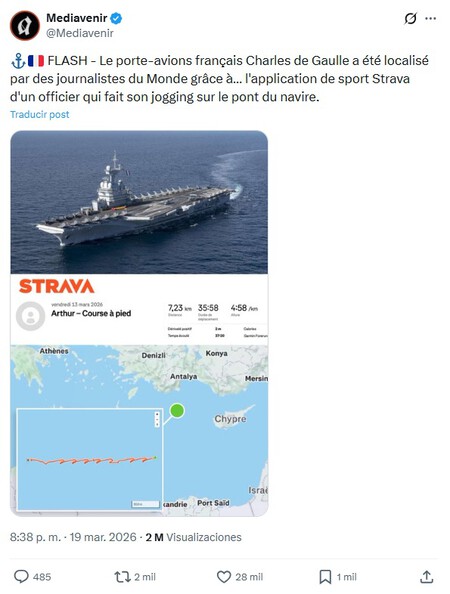
Recently, an unusual incident involving the French Navy caught the attention of the press. Journalists from Le Monde discovered a Strava activity that showcased an individual running in circles hundreds of kilometers from the nearest shore, in the vast Mediterranean Sea. The question on everyone’s mind was simple: what was a runner doing in such an isolated location?
The Revelation of Location
This incident raises significant security concerns, especially given that the individual in question was an officer aboard the aircraft carrier Charles de Gaulle. The Le Monde reporters knew the risks associated with Strava, an application that tracks and shares fitness data. By leveraging an online satellite viewer from Copernicus, they confirmed that the run’s location closely matched that of the Charles de Gaulle, immediately revealing the carrier’s position.
A Careless Oversight
On March 13, around 10:35 a.m., the young officer decided to jog around the deck of his ship, covering a distance of 7.23 kilometers in roughly 35 minutes. His smartwatch recorded and published this data on Strava, making it accessible to anyone, including journalists. This seemingly innocent act turned into a major security breach, as it revealed the real-time location of the aircraft carrier and its naval escort, which was navigating towards the northwest of Cyprus.
The Bigger Picture
Although it remains unclear whether the officer was aboard the Charles de Gaulle or one of its escort vessels, the implications of his Strava account are alarming. Just weeks prior, he had posted data from another run off the Cotentin peninsula. The pattern of his activities suggested that he often shared his locations, inadvertently providing valuable intelligence.
A Public and Private Discrepancy
It’s worth noting that while the movement of the Charles de Gaulle was public knowledge—having been ordered by President Emmanuel Macron to reposition from the Baltic to the Mediterranean—the details shared by the officer provided a near real-time account of the convoy’s movements. This presents a troubling breach of security, particularly given recent attacks on French forces in the Middle East.
Recognizing the Risks
The French Armed Forces General Staff has since acknowledged that the Strava publication did not comply with the existing digital security regulations. They are considering implementing appropriate measures to ensure that such oversights do not occur in the future. The incident has raised questions about the broader implications of technology like Strava, especially in sensitive military contexts.
StravaLeaks: A Growing Concern
Le Monde has categorized this event under the term “StravaLeaks,” a phenomenon they have previously highlighted. Prior incidents involved revelations about the movements of French nuclear submarines and even thousands of Israeli soldiers. The issue is not just limited to military personnel; security oversights have also involved bodyguards of world leaders who inadvertently shared their training routes online.
Conclusion: The Hidden Dangers of Sharing
This incident serves as a stark reminder of the potential risks associated with sharing location data through fitness apps. In an age where information can be easily accessible, individuals must exercise caution, especially when their actions could inadvertently compromise national security.
As we witness more such oversights, the need for stringent measures and awareness in the military and other sensitive sectors becomes ever more critical.
Images | Wikipedia