
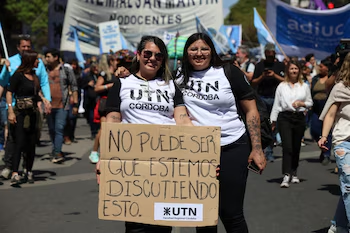
Impact of Cuarta Marcha Federal on Universities in Argentina
The Cuarta Marcha Federal Universitaria has emerged as a critical moment for public universities across Argentina, spotlighting the escalating conflict over the reduction in educational budget imposed by the national government. Set to occur on May 12, with the central event in Plaza de Mayo, protests are expected to resonate throughout the country, from Jujuy to Tierra del Fuego.
Call to Action by National University Councils
This protest is spearheaded by respected bodies such as the Consejo Interuniversitario Nacional (CIN), the Frente Sindical de Universidades Nacionales, and the Federación Universitaria Argentina (FUA). Their primary demand is for the executive branch to adhere to the University Financing Law, ratified by Congress in October 2025.
Budget Cuts and Their Implications
Universities in the interior of Argentina have voiced grave concerns regarding the budget cuts over the past two years. These cuts have severely impacted faculty and staff salaries, student scholarships, infrastructure projects, and crucial research activities. According to Franco Bartolacci, rector of the National University of Rosario (UNR), the transfers to universities have dropped by 45.6% since 2023, placing them at only half of their operational capacity.
New Administrative Cuts and Salary Concerns
The recent Administrative Decision 20/2026 announced a cut of $5.303 million to infrastructure funding for national universities, amidst a broader budget reduction of $78.768 million across the Secretariat of Education. Bartolacci emphasized the urgent need to address salary issues, noting the significant loss of qualified human resources due to resignations, particularly from those with extensive experience.
Effects on Faculty and Infrastructure
The fallout from these budget cuts is exacerbated by a pronounced loss of teaching and research staff. The National Technological University (UTN) has reported a staggering number of over 1,000 resignations, primarily driven by inadequate salaries. The faculty shortage is particularly acute in regional areas, where replacement teachers are increasingly difficult to find.
Infrastructure Stagnation
Many universities face halted construction projects. The National University of La Plata (UNLP), for instance, announced that it received no national infrastructure funds for 2026, forcing it to rely on internal reallocations to complete existing projects. Similarly, the National University of Mar del Plata (UNMdP) is struggling with multiple stalled initiatives, leaving programs underfunded and unable to meet the demands of a growing student body.
Social Impact of Budget Adjustments
Beyond academic ramifications, these budget cuts have profound social consequences. Many students at the National University of La Matanza (UNLaM) are forced to cut back on their course loads due to increased transport costs and stagnant scholarship funding. Experts predict that this will negatively affect graduation rates in the near future.
Legal Mandate for Funding
Recent judicial decisions have reiterated that the government must comply with the University Financing Law, emphasizing the urgency of addressing salary and scholarship allocations. As universities face chronic resource shortages, there is a growing consensus that without appropriate funding, the viability of Argentina’s public university system is at serious risk.
Concluding Remarks
The Cuarta Marcha Federal is not just a protest; it is a reflection of widespread concern across the academic landscape in Argentina. With calls for better funding, transparency, and adherence to legal mandates echoing from Jujuy to Tierra del Fuego, the message is clear: the future of public universities hinges on immediate action and commitment to financial sustainability.