

The World’s Largest Digital Camera is Now Operational
The world’s largest digital camera has officially begun its operations, and its initial findings have been nothing short of astounding . With decades of development finally paying off, this technological marvel is set to revolutionize our understanding of the universe.
Located at the Vera C. Rubin Observatory atop the picturesque Cerro Pachón in Chile, this observatory is home to a camera roughly the size of a small car. Boasting a staggering 3.2-gigapixel sensor , it holds the title for the most powerful camera ever built . Its capabilities promise to change the way we view the cosmos.
After more than twenty years of development, the capabilities of this camera go far beyond merely capturing “pretty pictures” of the universe. In just 10 hours of operation, the preliminary results have already outclassed years of data collected by other observatories worldwide.
What It Accomplished in Just 10 Hours
In this incredibly brief window, the Rubin Observatory managed to capture an astonishing 10 million galaxies . This is a mere 0.05% of the 20 billion galaxies that scientists aim to catalogue during the observatory’s primary mission. The scale of what it can achieve is mind-boggling and will significantly enhance our understanding of the universe.
Moreover, it uncovered 2,104 previously unseen asteroids . Comparatively, other observatories around the world typically discover about 20,000 asteroids in an entire year. Rubin has completed 10% of this annual work in just half a day. Among these discoveries, seven asteroids are classified as near-Earth objects, although all are currently deemed to pose no threat to our planet.
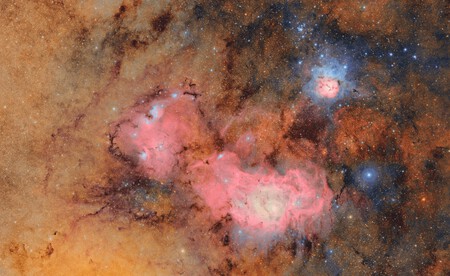
Trifid and Lagoon Nebulae as seen by the LSST camera of the Vera Rubin Observatory
The Camera Like No Other
Funded by the National Science Foundation (NSF) and the U.S. Department of Energy (DOE) , the Rubin Observatory is expected to gather more information about our universe than all prior optical telescopes combined. As noted by Brian Stone, the acting director of the NSF, this endeavor represents a monumental leap in astronomical research.
This innovative instrument is mounted on an 8.4-meter diameter telescope and comprises a Space-Time Legacy Survey Camera (LSST) weighing 2,800 kg. Each image it captures can cover an area of the sky equivalent to 45 full moons , further emphasizing its colossal capabilities.
Who was Vera Rubin?
The observatory is named after acclaimed American astronomer Vera Rubin , who provided some of the most compelling evidence for the existence of dark matter —an invisible substance believed to constitute 85% of the universe’s matter . The dynamic and ultra-precise mapping that the Rubin Observatory will generate over the next decade will play a crucial role in understanding the nature of dark matter.
Every night, the observatory will generate approximately 20 terabytes of data. By the end of its ten-year operational life, the total dataset will reach an astounding 500 petabytes . This means that in its first year alone, the observatory will collect more data than all previous optical observatories combined.
As it stands, the Vera C. Rubin Observatory represents a significant leap forward in the exploration of our universe. Its technological advances and sheer scale hold the promise of answering questions we have yet to consider, providing an invaluable resource for astronomers worldwide.