
Imagine a world where humanoid robots coexist alongside humans, not just in controlled environments, but as integral parts of our daily lives. As technology advances and costs decrease, the discussion surrounding these robots will shift from technical capabilities to ethical considerations . Questions will arise about their roles: How far can they go? Who will determine their limits?
Picture this: robots deployed as soldiers in conflict zones, working alongside human troops; robots serving as emotional companions for the elderly or anyone living alone; robots performing mundane tasks like cleaning and cooking; and robots tirelessly operating in factories, taking on roles once held by humans.
Surprisingly, many of these scenarios are no longer mere figments of our imagination. The robot Figure 02 , employed at a BMW factory since last year, is a prime example. This humanoid can operate autonomously, classify objects accurately, and execute tasks with a combination of “touch” and “short-term memory” , as its developers describe.
What once seemed like the realm of science fiction, as depicted in the 2018 video game ‘Detroit: Become Human’, is coming to life. Even its creator, David Cage , could hardly have predicted that by 2025 we would witness such advancements in real life. But here we are, and what’s truly fascinating is that Figure 02 does not operate in isolation. It is powered by a sophisticated neural network that is quietly revolutionizing robotics.
Helix: The Brain Behind Figure 02
This neural network, known as Helix , serves as the brain of the robot. It enables its movements to appear increasingly natural. Within just three months of its implementation in a logistics environment, Helix has demonstrated remarkable capabilities. It has learned not only to manipulate objects skillfully but also to understand context and adapt its actions based on previous experiences. Over time, it improves its speed and accuracy.
In its early days, Helix was tasked with simpler objects. As it has evolved, it now manipulates a wide variety of items, ranging from rigid boxes to deformable plastic bags—objects that are inherently challenging to grasp. Many of these bags crumple or slide easily, making them a true test of a robot’s adaptability.
Yet, Helix adjusts its grip based on the specific characteristics of each object. It modifies its strategy if the package is flatter or softer and knows when to switch to a more precise gripping tool . This adjustment happens in real-time, without explicit instructions about the type of package in front of it.
Rather than being programmed line by line, this skill was acquired through observation. Helix underwent training via 60 hours of human demonstrations . With each new example, its understanding of task execution deepened, leading to a notable decrease in the average time taken to process packages.
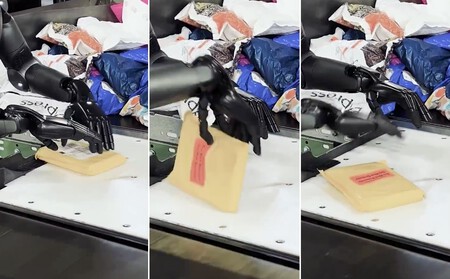
Helix isn’t just quick—it’s also highly accurate. The orientation of labels, which previously led to mistakes, is now correct 94.4% of the time. How? By learning to smooth wrinkled envelopes before scanning. A gentle press on the plastic is sufficient for the barcode to become visible—a small yet significant adjustment.
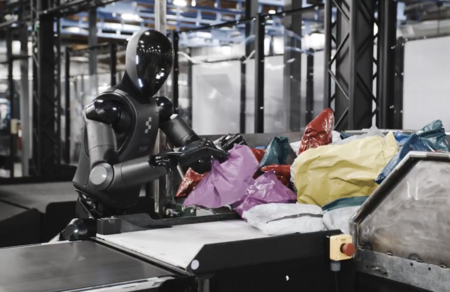
Integral to this learning process is memory. Helix is equipped with a vision system that not only analyzes its immediate environment but also retains visual information from moments prior. This short-term visual memory allows it to make more informed decisions. If it detects a package already rotated to a certain angle, it doesn’t repeat the action. If it initially fails to locate a label, it remembers its previous attempt and retries in that direction.
An additional breakthrough has involved tracking its own movements. Previously, each action stood alone: see, act, reassess. Now, Helix remembers the positioning of its arms , torso, or head moments ago, facilitating smoother movements. If something goes awry—like a package slipping—Helix can adjust its actions without starting from scratch.
The latest advancement includes a sense of touch . Not human-like, but a method of determining how much pressure it exerts on an object. This feedback lets Helix pause a movement if it meets resistance or adjust its motion based on the object’s weight. As a result, it can handle items more delicately, accommodating variations in weight and rigidity.
Forget theory; Figure 02 has already been put through its paces in real-world conditions. During a one-hour session, the robot operated without interruptions , autonomously classifying packages while leveraging all its capabilities: tactile sensitivity, short-term visual memory, and real-time error correction. These flawless demonstrations illustrate remarkable fluidity and precision in action.
Footage from this session reveals not only a robot functioning well but a neural network successfully navigating the complexities of the physical world. It highlights Figure 02 making decisions, adapting, and acting with a level of autonomy that would have sounded mythical just a short while ago.
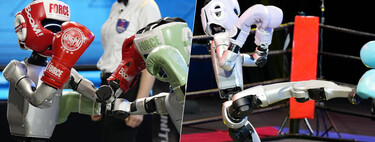
As companies like Tesla with Optimus , Boston Dynamics with Atlas , and Agility Robotics with Digit vie to dominate the humanoid robot market, Figure 02 progresses steadily along its own path—quiet yet effective. As time unfolds, we will be watching closely to see how this technology evolves.
Images | Figure AI
For further insights, explore how Google is advancing robotics through Gemini Robotics for real-world applications, or learn about NVIDIA’s multi-million-dollar AI supercomputer that operates using extensive cabling.