
The Ongoing Mystery of the “Wow!” Signal: New Insights Arise
Almost half a century after the Big Ear Radio Observatory captured an enigmatic signal of 72 seconds from space, the mystery has not only persisted but has grown more complex . An exhaustive re-analysis of the original 1977 data, which many believed to be lost, has revealed that the legendary “Wow!” signal was considerably stronger and moved towards us at a much higher speed than previously calculated.
A Little Context. On August 15, 1977, American astronomer Jerry R. Ehman recorded an extraordinarily intense narrow-band radio signal characterized by the sequence “ 6EQUJ5 .” His astonishment was such that he circled the code and wrote “Wow!” in the margin. Thus began one of the greatest enigmas in modern astronomy —the most famous candidate for an extraterrestrial transmission . A recent preliminary study posted at Arxiv.org significantly rewrites much of what we knew about this puzzling signal.
<img alt="Some researchers believed that they had captured a mysterious signal. It was just a microwave." width="375" height="142" src="https://i.blogs.es/620575/cisro-parkes-telescopio/375_142.jpeg"/>Rescuing a Treasure of 75,000 Pages. The new research has been akin to an archaeological endeavor. For years, it was assumed that the detailed data surrounding the “Wow!” signal had been lost, especially after the Ohio-based Big Ear Observatory was dismantled in 1998 to make way for a golf course. Fortunately, a group of volunteers rescued most of the telescope records .
Researchers from the Project “Arecibo Wow!”, led by Abel Méndez from the Planetary Habitability Laboratory of the University of Puerto Rico, undertook the monumental task of digitizing and analyzing more than 75,000 pages of the original forms using Optical Character Recognition (OCR) technology, combined with human oversight. This massive undertaking has allowed for the first time the application of advanced computational methods to the original signal data, uncovering details that had been overlooked for nearly 50 years .
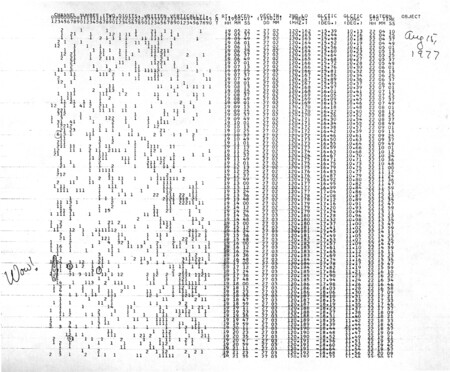
<span>The "Wow!" Signal next to the scribble of astronomer Jerry Ehman</span>Strong, More Precise, Faster. The recent analysis has refined the parameters of the signal and shed new light on its possible origins. Previous estimates of the signal’s intensity ranged from 54 to 212 janskys , but new calculations have revised that figure upwards to at least 250 janskys . This confirms that the signal was indeed more powerful than once thought, making it a truly exceptional cosmic event, as few known astrophysical radio emitters produce this level of intensity.
The frequency has also been adjusted to 1,420.726 MHz , suggesting that the object responsible for the signal was moving towards us at 74 km/s , a speed inconsistent with the typical rotation of objects in our galaxy.
Additionally, the research has narrowed the search area by two-thirds, refining coordinates to new locations that slightly differ from previous estimates. This could explain why decades of searches failed to detect the signal again.
Neither Humans nor Comets. With this updated data, many previously proposed explanations have been effectively ruled out. The study almost completely dismisses any human origin for the signal. At the time, no known satellites were present in that position, and the Moon was on the opposite side of Earth, eliminating the possibility of terrestrial transmission reflections.
Furthermore, television stations of that era were incapable of generating a harmonic at that frequency, and the specific form of the signal fits perfectly with what is expected from a point source through the telescope beam, further arguing against local interference.
The theory that the “Wow!” signal was caused by the passage of a comet—once thought to be an adequate explanation—has also lost credibility with the new analysis. The strength and characteristics of the revised signal do not align well with the hydrogen cloud surrounding a comet.
So What Was It? Perhaps the most tantalizing implication is that researchers have not completely ruled out the idea of extraterrestrial involvement; however, they lean towards natural astrophysical events that are extremely rare. Previous studies suggest that the signal could derive from a neutral hydrogen cloud —while common, such clouds typically do not emit signals of this intensity and narrow bandwidth.
According to this new assessment, the “Wow!” signal may have been the result of an Astronomical Mass Flare or an outburst from one of these clouds, similar to a natural microwave laser—a fleeting yet powerful event that could account for both the signal’s intensity and its absence in future observations.
In the quest for understanding the cosmos, the “Wow!” signal remains an enduring puzzle. Scientific efforts to decipher its origins may continue for years or even decades, yet the discoveries from this recent study will undoubtedly push the boundaries of our understanding of the universe.