
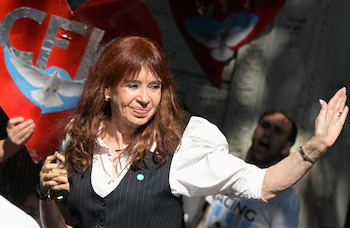
Felipe Solá’s Insights on Cristina Kirchner’s Judicial Situation
In a recent interview with Infobae, former Chancellor Felipe Solá discussed the complex dynamics surrounding Cristina Kirchner’s judicial challenges, labeling the situation as rooted in “political fear.” His statements shed light on the broader implications of this fear not just for Kirchner but for the Peronist party as it faces growing opposition, particularly from figures like Javier Milei.
The Impact of Political Fear
Solá articulated a strong belief that the current judicial conditions imposed on Kirchner are not solely matters of law and order, but rather dictated by political motivations. He emphasized that “the hyperrestrictive conditions are due to political fear.” This perspective invites a reflection on the nature of justice in political contexts, suggesting that rather than upholding the law, the motivations behind judicial actions may reflect a desire to limit Kirchner’s influence in Argentine politics.
Calls for Justice Reform
He made a compelling case against the idea of prison as punishment, arguing instead that justice should preserve those who have not committed crimes. Solá stated, “Justice has to show her the power to limit the power,” highlighting a critical assessment of how justice is being manipulated to control political figures.
Broader Judicial Implications
Solá also pointed out that the unequal treatment of political leaders like Julio De Vido and Héctor Timerman illustrates a broader trend of “political hatred.” He voiced concern over how such feelings affect judicial outcomes, asserting that biases in the legal system are not just coincidental but part of a larger pattern of political division within Argentina.
Peronism’s Crisis of Representation
Addressing the current state of Peronism, Solá critiqued the party’s communication strategy, indicating that it is struggling to connect with the Argentine populace effectively. He lamented, “They are not speaking to the Argentine people,” which conveys his concern over the party’s diminishing resonance in a time when robust dialogue is crucial.
Potential for Future Leadership
Looking ahead to the 2027 elections, Solá positioned himself as a likely candidate, though he acknowledged the challenges posed by outsiders entering the political fray. He expressed a commitment to party unity, stating, “I absolutely believe in unity,” and underscored the importance of collaborative efforts in shaping a cohesive political front in the future.
Economic Concerns and Regulatory Needs
In the context of economic discussions, Solá criticized dogmatic fiscal adjustments and pointed to a need for flexible economic strategies. He highlighted the lack of effective measures to address issues like inflation, adding that current methodologies for calculating it are outdated.
Conclusion: The Role of Artificial Intelligence
Wrapping up the discussion, Solá raised alarms regarding the absence of regulations surrounding the use of artificial intelligence in governance. He warned that unchecked AI advancements pose significant risks, indicating a critical need for policies that can protect human interests amid rapid technological changes.
In summary, Felipe Solá’s insights reflect complex political dynamics in Argentina, focusing on the interplay of justice, representation, and economic policies, all of which will undoubtedly shape the nation’s future.