

The Crisis in Colombia’s New Health Model for Educators
One year has passed since the introduction of the new health model for educators in Colombia, and the reality is far from the objectives promised by the national government. Designed to modernize the system and guarantee efficient care for over 800,000 teachers and their families, the implementation has led to numerous failures that directly impact the quality of service.
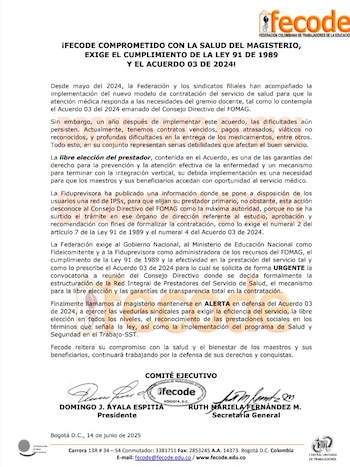
Some persistent issues include delayed payments, expired contracts, shortages of medications, and unacknowledged travel allowances. These problems were highlighted in a statement by the Colombian Federation of Educators (Fecode) on June 14. “The difficulties persist. We currently have expired contracts, delayed payments, unrecognized travel, and serious issues with medication delivery,” the union stated. “All of this represents serious weaknesses that affect the good service,” they warned.
Stay updated via ourWhatsApp Channel and on Facebook
Implemented on May 1, 2024, the model sought to eliminate regional operators that had served as intermediaries between health providers (IPS) and the Social Benefits Fund of Teachers (Fomag). The Fiduprevisora, a state trust, took on the task of contracting an open network of providers across the country. However, the transition has not been smooth. According to complaints from the teaching union, the Fiduprevisora lacks the technical and operational capacity to coordinate thousands of contracts with IPS in various regions.
One alarm-inducing issue was the Fiduprevisora’s publication of a network of providers for user choices. Fecode rejected this decision as it was made unilaterally and without approval from the Fomag Board. The union stated that it “disregards the FOMAG Board as the highest authority” and omits the necessary procedures required by Law 91 and Agreement 03.
The Fomag Board is responsible for reviewing and approving the structure of the provider network. Therefore, Fecode requested an urgent meeting to clarify the rules, ensuring “free choice and complete transparency in contracting,” while restoring channels for teacher participation.
The free choice of providers is one of the union’s most cherished rights. They argue that it ensures “one of the guarantees for effective prevention and care.” However, many teachers across the country report that this option is not realistically available. Available IPS often lack adequate coverage, and transfers for specialized care remain lengthy and costly.
In addition to structural failures, there is growing concern about the transparency of the model. Agreement 03 of 2024 established a multi-tiered design, combining a primary provider, a regional service node, and accessible centers of excellence nationwide. However, teachers report that, beyond documentation, the effective execution of this structure has not materialized.
The Fiduprevisora, which went from managing between 10 and 13 regional operators to directly handling contracts with thousands of IPS, faces an enormous challenge. Although no official figures are provided, estimates suggest that it must coordinate at least 13,000 contracts, requiring complex logistics and human resources that currently seem inadequate.

In light of this situation, Fecode urged the national government, the Ministry of Education, and the Fiduprevisora to respect existing regulations and strengthen the Health and Safety at Work (SST) program. The union also called on teachers to remain “alert in defense of Agreement 03 of 2024,” monitoring the situation and demanding “service efficiency and free choice at all levels.”
Meanwhile, thousands of teachers continue to work in classrooms without the certainty of having a health system that meets their most basic needs. The model that promised transformation is still far from fulfilling that promise.