
Mexico’s Victory Over South Africa: A Closer Look at the Three Expulsions
Mexico kicked off the 2026 World Cup with a convincing 2-0 victory against South Africa at the prestigious Aztec Stadium. The match was marked by the presence of three red cards, two for the South African team and one for Mexico, significantly impacting the game’s dynamics.
The First Expulsion from South Africa
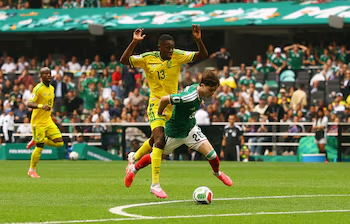
The game spurred into action right from the outset, leading to the first red card early in the first half. Mexican player Brian Gutiérrez was advancing towards the goal when South African defender Yaya Sithole fouled him from behind. The Brazilian referee, Wilton Sampaio, keenly identified this as an Obvious Goal Opportunity (OGE) according to Rule 12, justifying the expulsion.
Under the rule, several elements made the decision clear-cut: Gutiérrez was in control of the ball, there were no defenders in position to stop him, and his shot on goal was imminent. This red card effectively set the tone for Mexico’s dominance.
The Second Red Card Against South Africa
The second expulsion was initiated through VAR, overseen by Paraguayan official Juan Gabriel Benitez. This action came as Themba Zwane engaged in physical contention for the ball with Mexican player Roberto Alvarado. During this exchange, Zwane delivered a significant blow to Alvarado’s face.
Sampaio, upon reviewing the footage, confirmed that this was not merely incidental contact but a deliberate and forceful act, meriting a red card. The scrutiny from different angles, coupled with the intensity of the impact, underscored the action’s eligibility for disciplinary action. The blow was directly to the face, elevating the seriousness of the conduct substantially.
The Controversial Red Card for César Montes
As the game approached its conclusion, a controversial third red card was issued, this time to Mexico’s César Montes. This decision ignited debate among viewers and analysts alike. Montes’s foul disrupted the flow of an offensive play; however, the criteria for an OGE were not fully met.
While Khuliso Mudau was advancing, he was not in an immediate position to score, as considerable distance remained, and other defensive players could have intervened. As such, this foul should have been treated as a promising attack rather than a clear scoring opportunity. Critics argue that a mere warning would have sufficed instead of the harsh disciplinary action taken.
Conclusion
The match between Mexico and South Africa has not merely set the stage for the World Cup but has raised crucial discussions about officiating in high-stakes matches. With two expelling cards against South Africa and a controversial card for Mexico, the game highlighted both the urgency and the challenges of maintaining discipline on the football pitch. As the tournament progresses, the focus will likely remain on how similar situations are handled, particularly with the influence of VAR.
Looking ahead, Mexico will face South Korea next, while South Africa is set to compete against the Czech Republic. The outcomes of these matches will be critical as teams navigate the complexities of this prestigious tournament.