
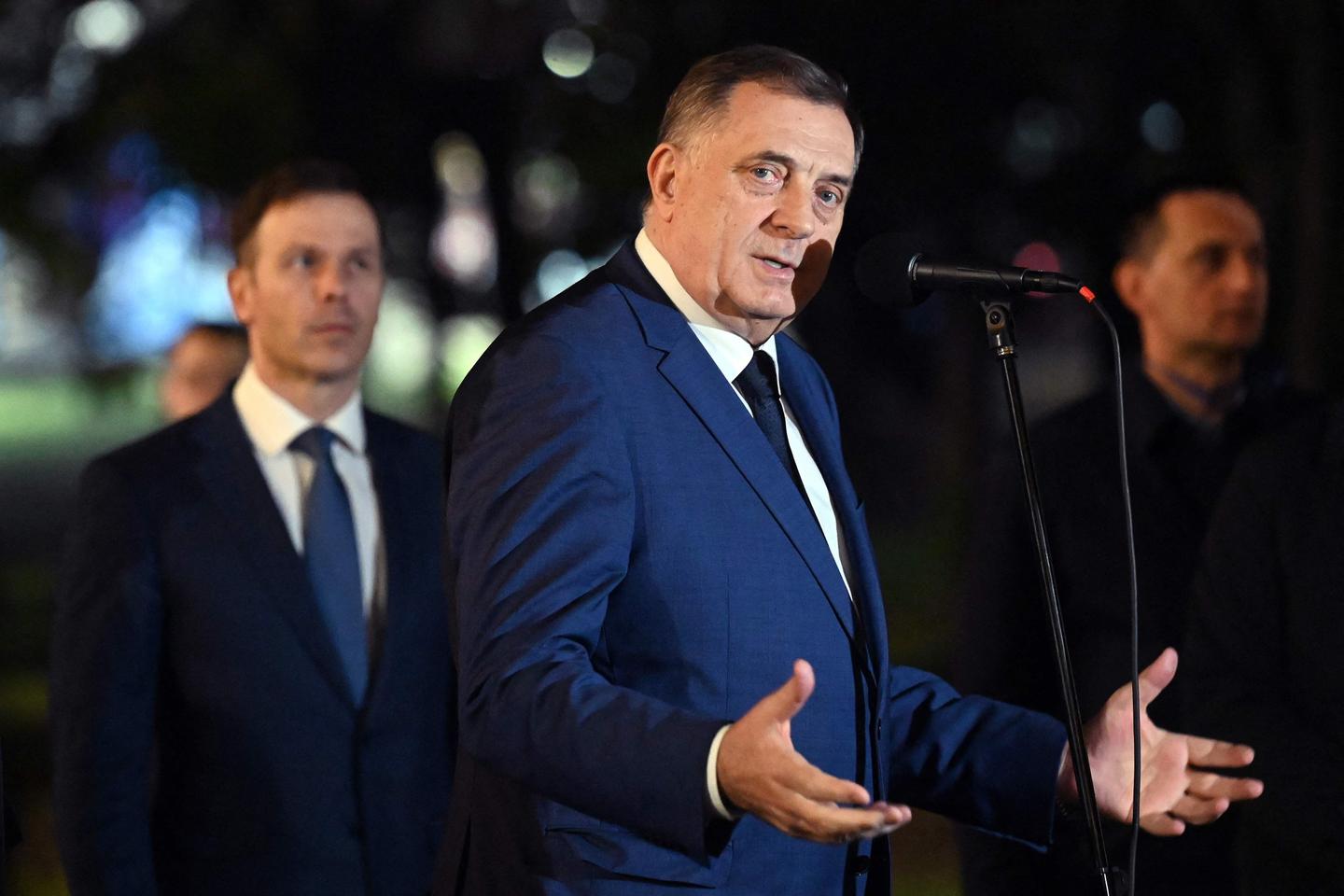
Reinforcements of the European Force (EUFOR) began to arrive, Tuesday, March 11, in Bosnia and Herzegovina, divided country of the Balkans where the situation was strongly tense after the legal condemnation of the political leader of Bosnian Serbs, Milorad Dodik, for non-compliance with the high international representative.
Almost thirty years after the war (1992-1995), the Parliament of the Serbian Republic of Bosnia (Republika Srpska) adopted several separatist laws at the end of February aimed at prohibiting the police and the justice of the central state to exercise in this entity of the Bosnia Serbs.
“From today, the reserve forces will begin to arrive in Bosnia and Herzegovina by land (…) and by air “said the Eufor headquarters in a press release. Three European countries – the Czech Republic, Italy and Romania – will send these reinforcements, with vehicles and helicopters. Their deployment will be “In the coming days”according to the press release.
A unit of Romanian soldiers arrived during the day at Sarajevo airport aboard a troop transport plane, according to images broadcast by EUFOR. In addition, several helicopters of the Italian army arrived in the Eufor database in Butmir, in the suburbs of Sarajevo, announced the Eufor mission in Bosnia on Facebook. European strength announced on Friday a “Temporary increase” of his troops on site, “A proactive measurement (…) in the interest of all its citizens ”. The number of additional soldiers has not been communicated, as is the current staff of the on -site mission (Althea).
The international community will not “leave a security vacuum” in the country
According to a press release from an Austrian parliamentary mission, which made a visit to the troops deployed in Bosnia in February, European force has 1,500 people in this country.
The president of the Republika Srpska, Milorad Dodik, was found guilty on February 26 by the Court of State, to Sarajevo, of non-compliance with the decisions of the High International Representative, Christian Schmidt, responsible for ensuring compliance with the Dayton Peace Agreement. He was sentenced to a prison sentence, accompanied by a ban on exercising his functions for six years. He can appeal, but he rejected the verdict. In response, the Parliament of the Republika Srpska adopted legislation rejecting authority in the Serbian entity to the State Prosecutor’s Office – which charged Mr. Dodik -, of the Court of State – who condemned him -, and the Central Police (SIPA).
NATO secretary general, Mark Rutte, assured Sarajevo on Monday that the international community would leave “Not a safe vacuum” in the country.