

Regulating Short-Term Rentals in Spain: A New Era for Tourists and Residents
With international tourism on the rise, Spain is amidst a crucial challenge—balancing the interests of tourists with the concerns of local residents. The government is taking steps to regulate short-term rentals , as a surge in such accommodations has begun to impact housing availability in cities across the country. Recently, a system called the Single Window and a new registration number were introduced, aiming to ensure that those renting properties to tourists adhere to legal standards.
The Ministry of Housing and Urban Agenda (Mivau) has reported keen interest from property owners. As of now, more than 215,400 applications have been submitted by owners seeking a registration number. This number is essential for listing properties on popular platforms like Airbnb and Booking.com following new regulations established in Spain.
Data from the government reveals that slightly over half of these requests, around 134,300 , were received just last month. Currently, there are 94,200 applications fully approved and 102,700 provisionally accepted, pending final approval from the College of Registrars. Unfortunately, 18,500 applications have been denied due to various compliance issues.
Despite early setbacks, the demand for registration numbers has shown persistent growth. Recent calculations indicate that applications have surpassed 260,000 , suggesting an ongoing trend towards compliance and potentially increasing the overall number of operational short-term rentals across Spain. In fact, property managers estimate peaks of 30,000 applications received daily at the start of July, although that number has now leveled off to around 10,000 to 15,000 daily.
Moreover, approximately 22,000 applications have been rejected, mainly due to critical errors: lack of necessary licenses, absence of community owners’ endorsements, or miscategorization of the properties, among other issues.
It’s noteworthy that not all registration applications stem from owners looking to rent to tourists . A significant proportion aims to enter the seasonal lease market , catering to professionals like researchers, students, and temporary workers. Currently, 78.9% of applications are aimed towards tourist rentals, while 21.1% seek seasonal leases.
Hence, both categories are included under the umbrella of short-term rentals. The objective, as outlined by Minister Isabel Rodríguez , is to eradicate illegal tourist rentals that disrupt neighborhoods and exacerbate housing shortages, ultimately ensuring that such rentals do not flout local regulations.
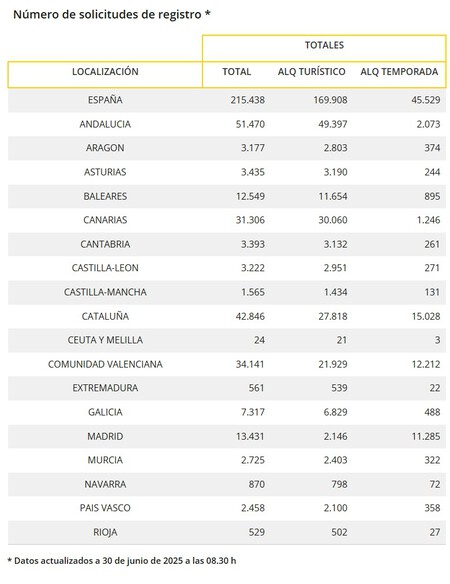
The data compiled by the Ministry provides further insights into the regions most affected by short-term rentals. Notably, 82.22% of the confirmed applications for tourist rentals come from five regions: Andalusia, Balearic Islands, Canary Islands, Catalonia , and the Valencian Community .
This concentration suggests that more than three-quarters of applications across Spain are focused in these areas, underscoring both their popularity as tourist destinations and the housing pressure they face.
A closer examination reveals hotspots within these territories. In Andalusia, for instance, 49,397 applications were recorded, with the majority— 27,936 —concentrated in Malaga . Similarly, the Canary Islands show significant activity, with Gran Canaria and Tenerife accounting for 16,710 and 13,300 applications, respectively.
Catalonia and the Valencian Community also show high demand. In Catalonia, municipalities along the coast processed the bulk of applications, while Alicante and surrounding areas in Valencia propelled local numbers significantly.
Though these statistics reveal a growing regulatory landscape, they also indicate a dynamic environment for both property owners and locals. The push for conformity aims to stabilize the real estate market and ensure that tourism does not eclipse the need for sustainable living conditions for residents.
As Spain continues to adapt to the challenges of short-term rentals , the government hopes to strike a balance that satisfies both tourists eager to explore the vibrant culture and residents seeking stable and accessible housing. The outcome of these measures will likely shape the future of urban living in major Spanish cities.
Images from various sources highlight the ongoing trends in this domain, emphasizing the importance of constructive regulation in managing tourist housing while preserving community integrity.
In summary, Spain’s effort to implement a registration system for short-term rentals marks a pivotal step in reconciling the needs of tourists with the concerns of local residents—promoting a sustainable future amid growing international tourist demands.