
The Unlikely Origins of the Disney Bomb: A Military Marvel
The morning of last Sunday , June 22, the United States deployed its B-2 stealth bombers with a remarkable mission : to launch its new MOP bombs on Iranian bases for the first time. These massive bombs, specifically engineered to penetrate underground facilities, symbolize a significant leap in military technology. Interestingly, despite their advanced capabilities, the conceptual roots of these weapons trace back to the Second World War , during which the British pioneered techniques for neutralizing fortified targets.
A Disney movie sparked this innovation.
World conflicts historically ignite the creative prowess of nations, leading to groundbreaking inventions aimed at warfare. The First and Second World Wars marked technological revolutions , and the Cold War ushered in the age of nuclear arms. Nations embroiled in conflict strived for superiority , consistently seeking to develop “the biggest bomb.”
During the mid-World War II, British engineers sought a powerful bomb with a distinct purpose: to penetrate bunkers and destroy Nazi submarine factories. They succeeded in creating the Tallboy and Grand Slam bombs, weighing five and ten tons respectively, designed to hit nearby targets, penetrate the earth, and damage structures through powerful shock waves .
This approach was innovative, but the British required a more effective means of direct impact. Their inspiration came unexpectedly from a Disney propaganda film .
Edward Terrell , an officer in the Royal Reserve of Naval Volunteers, was among those who viewed this film. Afterward, he and his colleagues contemplated the feasibility of designing a bomb capable of drilling through concrete, inspired by a scene from the movie instead of relying solely on the earthquake effect of their existing bombs.
In September 1943 , engineers commenced work on this innovative bomb. Despite some opposition, Churchill greenlit the project, paving the way for advancements in military explosives.
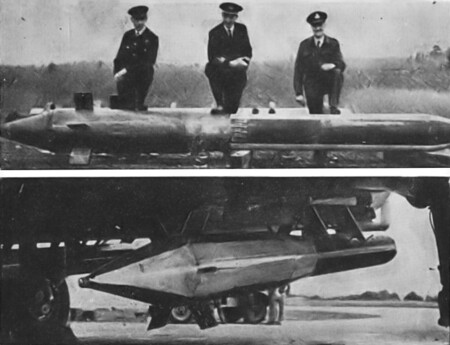
Edward Terrell and two other RAF officers with a Disney bomb
This Disney bomb , officially named the “4,500-pound concrete-penetrating bomb,” possessed a massive presence—not due solely to its size but also its weight and explosive potential. Over five meters long and 43 centimeters in diameter, it weighed approximately 2,000 kilograms , powered by RP-3 rockets and loaded with 230 kilograms of a World War I explosive formulation called Shellite .
Designed to be launched from Boeing B-17 or B-29 aircraft, it utilized the rockets to achieve speeds exceeding 1,500 km/h, penetrated structures with kinetic force, and detonated within the target. It could penetrate reinforced concrete up to 5 meters , capable of causing severe damage to enemy installations.
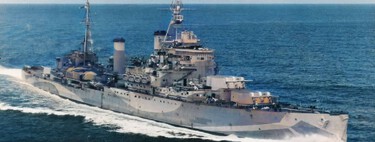
Despite its promise, the Disney bomb suffered from timing issues, as it was not operational until near the war’s end . In January 1945, tests began, leading to its deployment by the United States Air Force.
Between February and April 1945 , a total of 158 Disney bombs were deployed against German bunkers and submarine facilities. The primary target was a U-boat factory known as Valentin , which was nearing completion. Although some damage was inflicted, previous bombings had already compromised the facility.
Unfortunately, the bomb’s performance was disappointing for several reasons. Foremost, it was too late to influence the outcome of the European Theatre significantly. Their impact was not substantial, exemplified by the attack on the Valentin bunker , where over 60 bombs were launched but only one achieved direct impact—resulting in limited damage.
Further investigations in the post-war era revealed that lighting failures occurred in 37% of Disney bombs during controlled detonations, significantly hampering their effectiveness, with some detonating prematurely. However, it was established that the bomb could penetrate over 5.08 meters of concrete, a noteworthy achievement for its time.
Despite its lackluster operational history, the Disney bomb laid the groundwork for future penetration weapons . The legacy of this unconventional weapon evolved into the development of the GBU-57A/B , known as the Massive Ordnance Penetrator (MOP). This modern bomb measures 6.25 meters long and weighs a staggering 13,600 kilograms , of which 2,400 kilograms consist of explosives, capable of penetrating up to 60 meters of concrete.
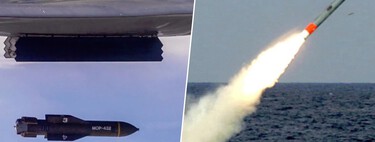
Additionally, the MOP benefits from laser guidance , allowing for precise targeting, a significant enhancement compared to its World War II predecessor. This trajectory of development underscores humanity’s capacity for innovation, particularly in adapting to the grim realities of warfare.
In summary, the evolution from a Disney-inspired weapon to modern-day munitions illustrates not only technological advancement but also the persistent drive for military superiority . As the arms race continues, the ingenuity behind these weapons reflects the complexities of modern warfare and the continually evolving landscape of global conflict.